
Liquid cooling in AI data centres: what it costs – and where the noise goes
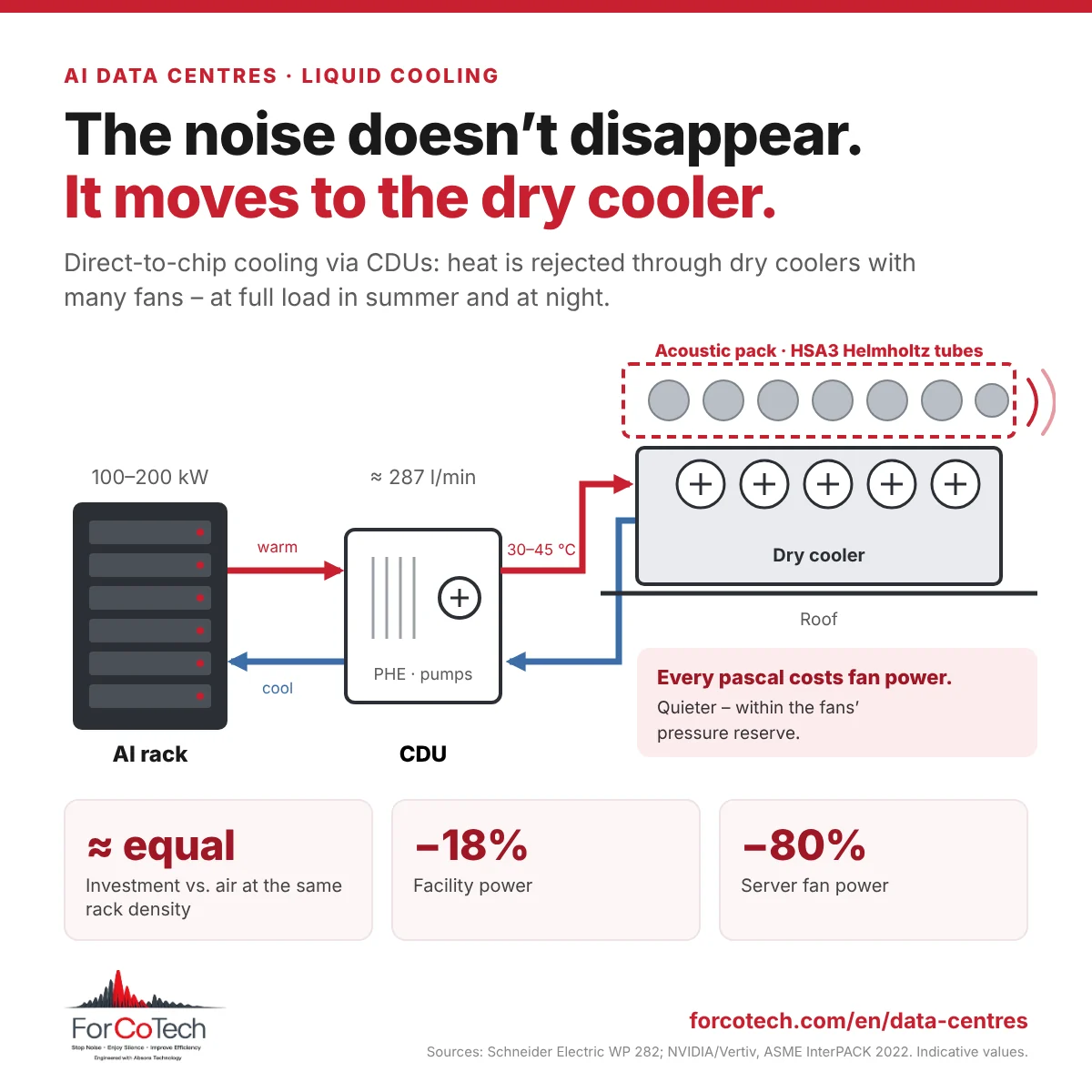
AI racks with 100–200 kW can no longer be cooled with air. Direct-to-chip cooling via coolant distribution units (CDUs) is becoming the standard in data centres. How does the cost compare with air cooling – and what does it mean for noise control?
How a CDU works
The CDU separates two loops via a plate heat exchanger (PHE): the technology cooling system (TCS) carries coolant to the cold plates on GPUs and CPUs, the facility water system (FWS) takes the heat to the dry cooler or chiller. Variable-speed pumps, filters, an expansion tank, an air separator, sensors and controls keep temperature, flow and pressure stable.
A simple calculation shows the scale: a 200 kW rack needs about 4.8 kg of water per second at a 10 K temperature rise – roughly 287 l/min (Q = ṁ · cp · ΔT).
Investment (CAPEX): about equal – cheaper through density
- At the same rack density Schneider Electric finds practically equal costs for a 2 MW data centre: $7.02/W with air, $6.98/W with liquid (10 kW/rack).
- At higher density costs fall: about 10% at 20 kW/rack, about 14% at 40 kW/rack – fewer racks, less floor space, smaller building.
- What goes: chillers and air handlers largely; UPS and switchgear shrink because server fans disappear.
- What is added: CDUs, pumps, piping, dry coolers. Retrofitting existing halls costs considerably more than a new build.
Operation (OPEX): less power, more free cooling
- NVIDIA/Vertiv measurement study (1–2 MW, 50 racks, direct-to-chip with CDUs): at about 75% liquid share, facility power fell by 18% and total power by 10%. Server fans needed 80% less.
- Warm water instead of chillers: the loops run at supply temperatures of typically 30–45 °C, so the dry cooler provides free cooling for many hours a year without compressors.
- PUE is misleading: in the study it only fell from 1.38 to 1.34 because IT power falls too. TUE is more meaningful – it improved by 15.5%.
Noise control: the noise moves to the dry cooler
Liquid cooling does not make the noise disappear. Heat is rejected through large dry coolers with many fans that run at full load in summer and on warm nights – exactly when the strictest night-time limits apply.
- Every pascal costs fan power. A silencer with a high pressure drop eats up the efficiency gain of liquid cooling or costs cooling capacity on hot days.
- Our acoustic packs with HSA3 metal acoustics and Helmholtz tubes reduce the noise level within the fans’ pressure reserve – non-combustible (A1), no mineral wool.
- Low frequencies under control: after attenuation, the 63 Hz band usually determines the level. The tubes’ resonance chambers are tuned to exactly that.
See how this looks for a reference data centre on our data centre solutions page.
Sources: Schneider Electric, White Paper 282 (2 MW, immersion cooling, 2020); NVIDIA/Vertiv, ASME InterPACK 2022 (1–2 MW, direct-to-chip with CDUs). Indicative values – no substitute for a project-specific business case.