
Acoustic enclosures for VRV units on an inner-city hotel – noise at nearby penthouse apartments
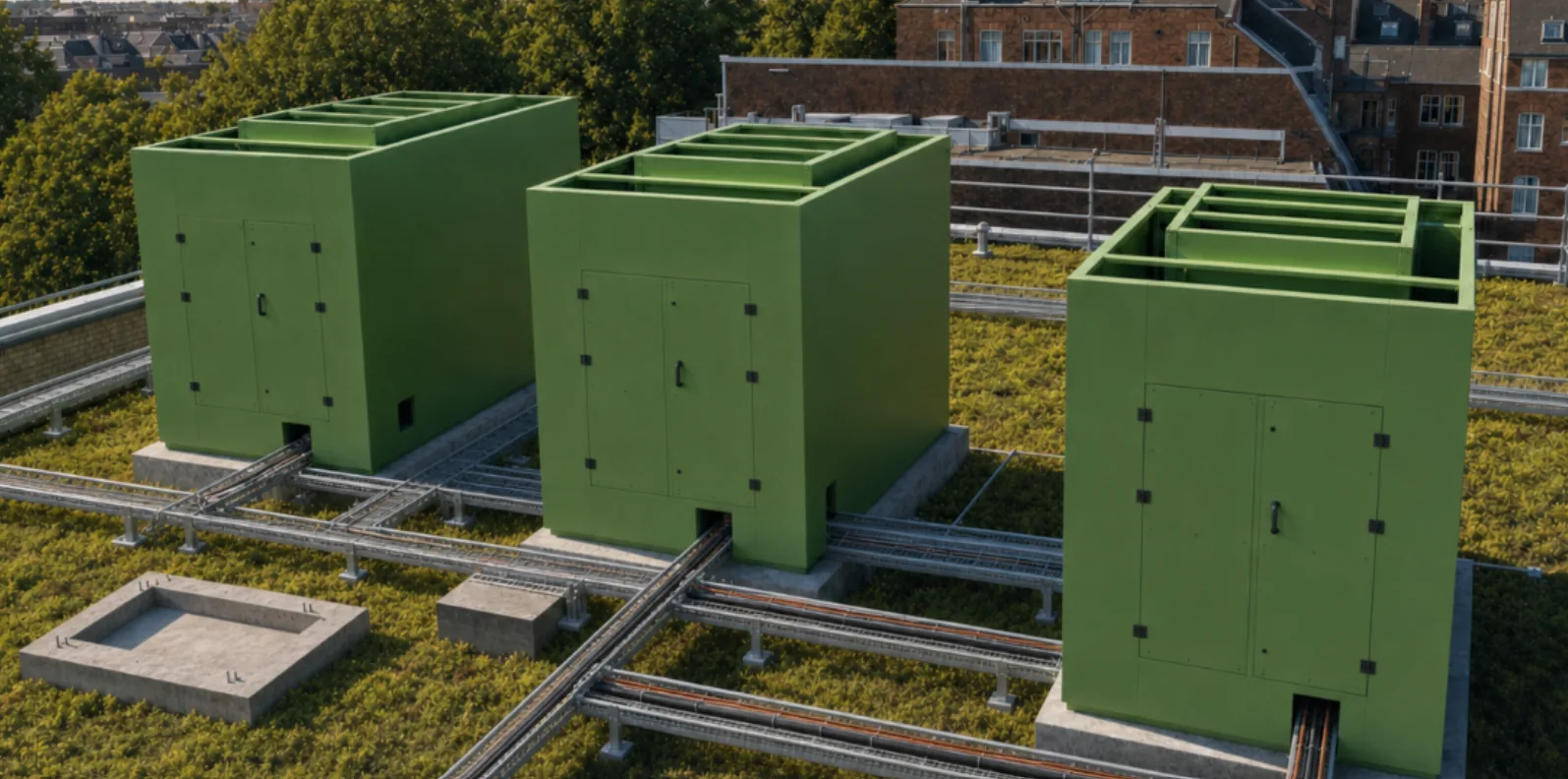
Individual enclosures for 3 Daikin VRV units
On an inner-city roof in France, right next to penthouse apartments, three Daikin VRV units were each fitted with an individual acoustic enclosure. With an air volume of 32,000 m³/h per unit, night-time operation in particular caused considerable noise for the neighbouring residents – which triggered this noise control project. The units air-condition the rooms and the conference centre of a hotel. Since they were already sized at the limit of their capacity, running them at reduced output was not an option.
Acoustic concept
To reduce sideways sound radiation effectively, both the air inlet and the air outlet were moved consistently upwards into the roof of the enclosure. This arrangement directs the noise away from the sensitive surroundings and minimises horizontal radiation towards the apartments.
Deliberately different air velocities for exhaust and supply air also reliably prevent air short-circuiting between inlet and outlet – a decisive factor for the long-term performance of the VRV units.
The exhaust air passes through 60 cm deep silencer splitters lined with “Stratocell Whisper 50 mm FR”. The honeycomb-like structure of the Whisper insulation provides high sound absorption and a clear reduction of airborne noise. The side panels are lined on the inside with the same material and prevent sound from spreading in a cone towards the noise-sensitive receivers at the sides.
- Air inlet and outlet in the roof: no side openings facing the apartments.
- Different air velocities: no short-circuit between supply and exhaust air.
- 60 cm splitters: absorptive lining in the exhaust path.
- Lined side panels: no sideways sound propagation towards the receivers.
Construction
The base frame of each enclosure is built from sturdy industrial T-slot profiles, which ensure high stability and flexible assembly. The aluminium panels are inserted into the profile slots from the outside. This allows a clean, service-friendly design with removable elements for maintenance access. Because the profile structure is no longer visible, the enclosures also look better – as if cast in one piece.
Why T-slot profiles?
For a long time I resisted using industrial T-slot profiles for the frame and always preferred aluminium plug-in profiles – until, after the first projects, I realised that slot profiles offer many advantages:
- much higher stiffness against deflection,
- high load capacity thanks to tested screw connections,
- great flexibility for mounting additional elements such as silencer splitters, absorbers and air partitions directly in the profile slot – positioned to the millimetre.
Originally published in German on silent-mode.com