|
NEWSWe specialize in reducing noise emissions and increasing the performance of HVAC and industrial systems.
|
|
The surface of STRATOCELL® WHISPER® FR panels, which we use as internal insulation of sound hoods for HVAC systems, were modified in a trial for optimized sound absorption and equipped with additionally punched and attached round Whisper molded parts. The punch hole served as an additional air cushion. The die-cut and applied STRATOCELL® WHISPER® molded parts further improve the overall absorption of Whisper panels by increasing effective sound wave penetration and surface roughness. We used round WHISPER moulded parts with a diameter of 5 cm and a depth of 5.5 cm, which were punched directly from the panels. These modifications improve sound absorption in the mid- and high-frequency ranges, as they allow for more angles of incidence for sound and promote resonances. The total NRC (Noise Reduction Coefficient) values of the panels increase by 10-20% according to our measurements, depending on hole diameter, depth and degree of coverage. Absorption EffectsThe perforated or round punched parts increase absorption by directing sound waves into the porous polyethylene structure, which minimizes reflections. The attached elements act like diffusers that scatter sound waves to reduce echoes without significantly reducing the self-sustaining capacity of the panels. Romolo Vicari / 08.01.2025 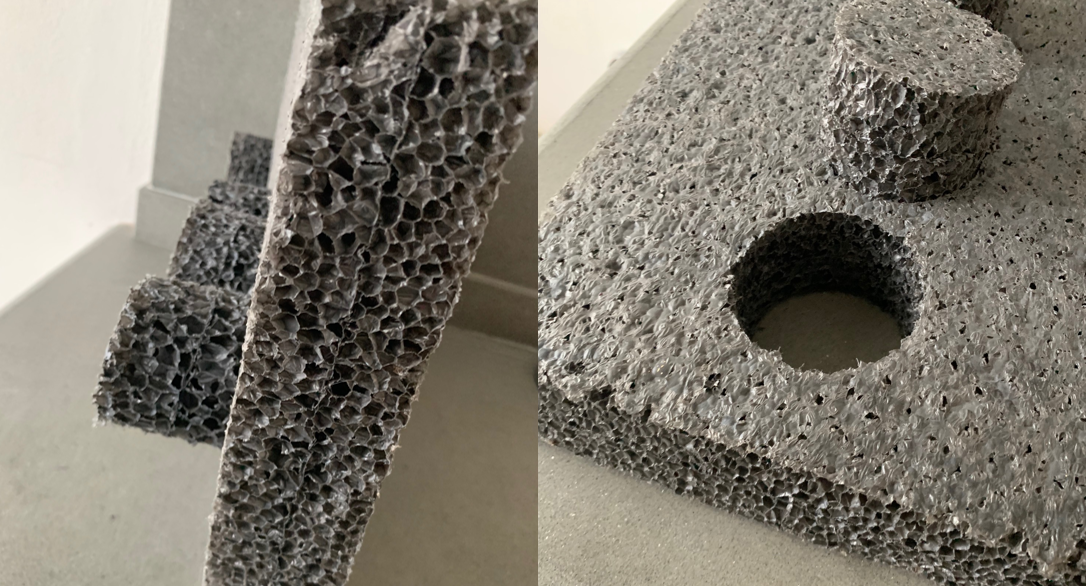
0 Comments
Underwater sound propagation from offshore wind farms, oil rigs, underwater data centers, etc.7/1/2026 Sound travels much faster and farther in water than in the air, as water is a denser medium. The speed of sound is typically around 1480 m/s in the ocean, depending on temperature, salinity and pressure, compared to air where the speed of sound is 340 m/s (reference 20° degrees outside temperature with a relative humidity of 50%). Offshore wind farms, offshore drilling platforms and now also the construction of underwater data centers generate underwater noise, especially during construction by driving foundation piles, as well as during operation by vibrations of the turbines. The following sound sources are to be distinguished Construction phase: Pile driving work generates impulsive peak levels of up to 250 dB, which can be heard for miles. Operation: Continuous noise from gearboxes, generators with levels around 100-160 dB at a distance of 100 m. High sound levels disturb marine fauna and lead to hearing damage, stress, injury or even death, for example in porpoises, whose biosonar is disturbed. Fish such as cod suffer masking effects that hinder foraging and flight, as well as population weakening. Around 150 species are affected, including krill, whales and dolphins, with consequences such as reduced reproduction and immune deficiency. Sound-reducing techniques significantly reduce underwater noise during the construction of offshore wind farms, they can greatly reduce noise levels and minimise area dispersion, which is significantly higher in the water than in the air. Bubble Curtains: Perforated hoses form air bubble rings around the ramming point that refract sound waves, while double variants such as Big Bubble Curtain achieve reductions of 18 dB. Cofferdams: Temporary housings around the pile that insulate sound, often combined with bubble curtains. Hydro Sound Damper (HSD): Air-filled balloons or foam elements in nets, adaptable to frequencies. Alternative foundation methods Drilling techniques, suction buckets or floating foundations completely avoid pile driving and generate less noise. Soft-start methods slowly increase hammer energy, supplemented by deterrence systems such as Pingers to displace the animals in the area. 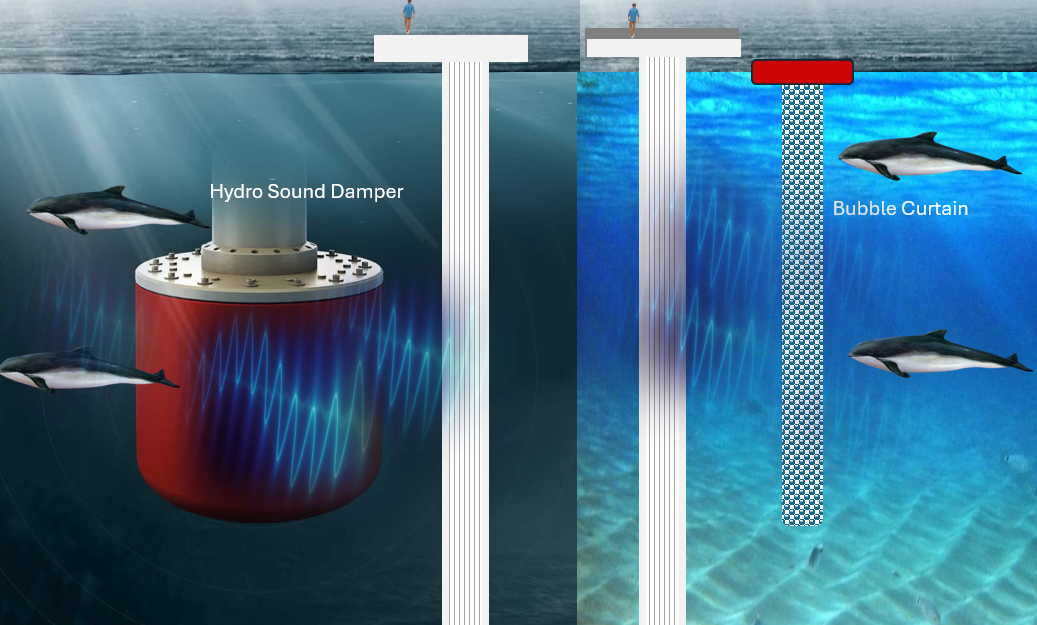 Influence of temperature and humidity on the propagation of airborne sound in the atmosphere6/1/2026 Airborne sound is attenuated as it propagates in the atmosphere depending on frequency, temperature and humidity; this is particularly relevant at medium and high frequencies and large distances between the sound source and the receiving location. With increasing temperature and medium to high humidity, both the speed of sound and the strength of absorption change significantly. Airborne sound absorption is the conversion of sound energy into heat through molecular friction and relaxation processes of the air components.The atmospheric absorption coefficient is usually given in dB per 100 m and increases sharply with frequency; low frequencies are much less attenuated than high frequencies. Influence of temperature The speed of sound in the air increases with temperature and is at 0 °C at about 331 m/s, at 20 °C at about 343 m/s and at 35°C at 352 m/s . With increasing temperature, the relaxation processes of the air gases shift, which changes the frequency-dependent absorption; at high frequencies, the air attenuation can increase significantly with temperature. Influence of humidity Humidity changes the composition and relaxation properties of the air, which changes the atmospheric absorption coefficient as a function of frequency and relative humidity. For many frequencies above about 1 kHz, the absorption initially increases with increasing relative humidity up to the range of 20% and then decreases again at even higher humidity. Very dry as well as very humid air therefore attenuate high-pitched sounds to varying degrees. Practical significance In normal indoor spaces, material and surface absorption dominate. Air absorption only becomes relevant in large rooms or outdoors at distances of tens to hundreds of meters. Particularly in the case of traffic noise, aircraft noise, noise from industrial plants or sound reinforcement over long distances, temperature and humidity profiles must be taken into account in measurements because they can noticeably reduce the levels of high frequencies at the receiving location. Calculation / Standards For technical calculations of air absorption, the ISO 96131 standard is often used, which indicates the atmospheric absorption coefficient as a function of temperature, relative humidity and frequency. The standard takes into account frequencies from 50 Hz - 10 kHz), temperatures from -20°C - +50°C, a relative humidity of 10% - 100%) and air pressure.  Forcotech Schallschutz - Schallausbreitung in der Atmosphäre |
AuthorWe specialize in reducing noise emissions and increasing the performance of HVAC and industrial systems. Archives
March 2026
Categories |
 RSS Feed