|
NEWSWe specialize in reducing noise emissions and increasing the performance of HVAC and industrial systems.
|
Underwater sound propagation from offshore wind farms, oil rigs, underwater data centers, etc.7/1/2026 Sound travels much faster and farther in water than in the air, as water is a denser medium. The speed of sound is typically around 1480 m/s in the ocean, depending on temperature, salinity and pressure, compared to air where the speed of sound is 340 m/s (reference 20° degrees outside temperature with a relative humidity of 50%). Offshore wind farms, offshore drilling platforms and now also the construction of underwater data centers generate underwater noise, especially during construction by driving foundation piles, as well as during operation by vibrations of the turbines. The following sound sources are to be distinguished Construction phase: Pile driving work generates impulsive peak levels of up to 250 dB, which can be heard for miles. Operation: Continuous noise from gearboxes, generators with levels around 100-160 dB at a distance of 100 m. High sound levels disturb marine fauna and lead to hearing damage, stress, injury or even death, for example in porpoises, whose biosonar is disturbed. Fish such as cod suffer masking effects that hinder foraging and flight, as well as population weakening. Around 150 species are affected, including krill, whales and dolphins, with consequences such as reduced reproduction and immune deficiency. Sound-reducing techniques significantly reduce underwater noise during the construction of offshore wind farms, they can greatly reduce noise levels and minimise area dispersion, which is significantly higher in the water than in the air. Bubble Curtains: Perforated hoses form air bubble rings around the ramming point that refract sound waves, while double variants such as Big Bubble Curtain achieve reductions of 18 dB. Cofferdams: Temporary housings around the pile that insulate sound, often combined with bubble curtains. Hydro Sound Damper (HSD): Air-filled balloons or foam elements in nets, adaptable to frequencies. Alternative foundation methods Drilling techniques, suction buckets or floating foundations completely avoid pile driving and generate less noise. Soft-start methods slowly increase hammer energy, supplemented by deterrence systems such as Pingers to displace the animals in the area. 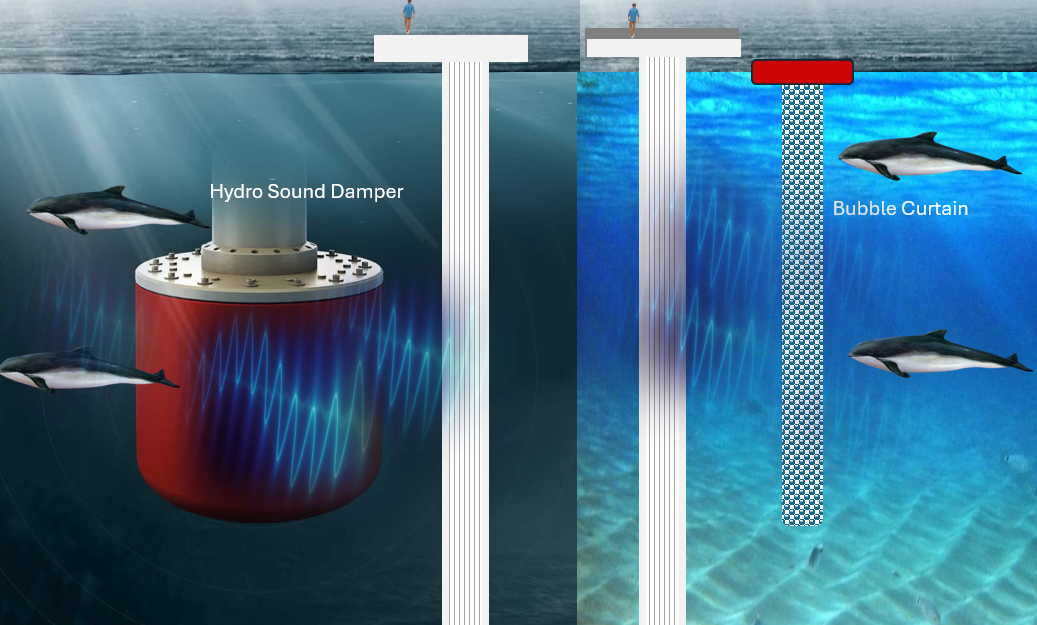
0 Comments
Leave a Reply. |
AuthorWe specialize in reducing noise emissions and increasing the performance of HVAC and industrial systems. Archives
January 2026
Categories |
 RSS Feed