
IoT monitoring up to the ATEX solution
Wireless sensors measure pressure drop, air velocity, temperature, sound level, power consumption and refrigerant. Operation then shows what the design promises: noise limits met, pressure drop within the reserve, no extra consumption, a tight refrigerant circuit. Transmitted via LoRaWAN, retrofittable – in explosion-proof design for R290 units.
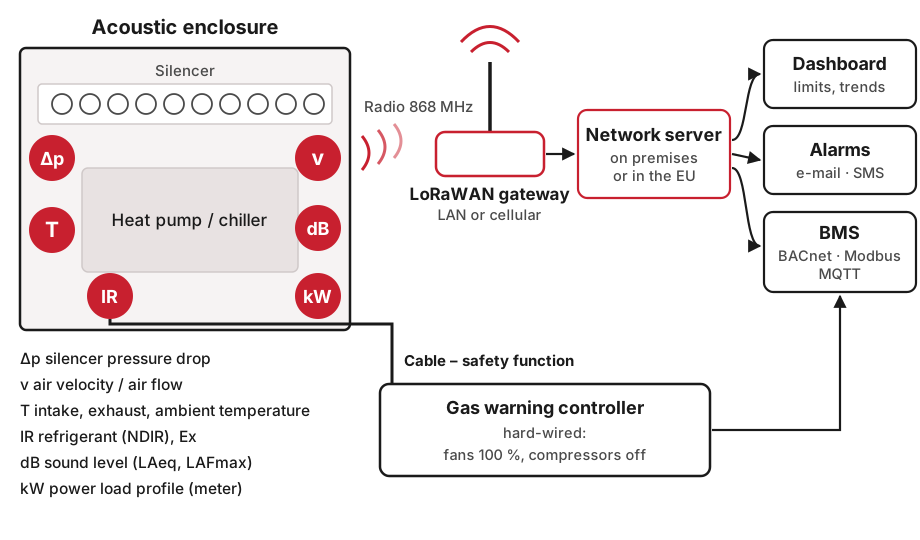
The enclosure is designed – operation shows whether it stays that way
We design acoustics and air flow in advance by calculation and CFD. In operation, leaves, snow, dust, wind and part load change the conditions. Measuring reveals deviations before capacity, efficiency or safety suffer.
- Fouling: leaves, pollen and dust in the silencers increase the pressure drop – the fans work against their reserve.
- Recirculation: warm exhaust air drawn back in costs capacity. It shows up as a temperature difference between intake air and ambient.
- Refrigerant loss: small leaks go unnoticed for a long time – with consequences for efficiency, F-gas obligations and, with R290, for safety.
- Sound level in operation: the continuous level shows whether the limits are met at night and at full load – complaints can be answered with data.
- Power consumption: the load profile shows what the unit actually consumes. Rising power at the same operating point points to fouling or recirculation.
- Evidence: measured values show operators and consultants that the enclosure does not slow the unit down.
- Condition-based maintenance: cleaning and service when the data call for it – not by the calendar.
Six measured variables, one radio network
Pressure drop
Differential pressure sensors across the intake and exhaust silencers measure the pressure drop in Pa and compare it with the design value and the unit’s pressure reserve. If it rises, cleaning is due.
Air velocity and air flow
Measured in the silencer gap or at the air outlet. This gives the air flow per operating case – a check of the design velocity and an early warning of blocked cross-sections.
Intake, exhaust, interior
Sensors at the intake, outlet and ambient. If the intake air is warmer than the outside air, the unit is drawing exhaust air back in. For inverters and battery storage: monitoring of the enclosure’s interior temperature.
Leak detection by infrared (NDIR)
Infrared sensors detect refrigerant at low level, where it accumulates – for HFC/HFO (e.g. R32, R410A, R454B), CO₂ (R744) and propane (R290). Selective and stable over the long term, alarm thresholds in ppm or % LFL.
Continuous sound monitoring
Sound level sensors on the enclosure or at the relevant receiver point transmit LAeq and LAFmax per interval, separately for day and night. This keeps the effect of the enclosure visible throughout operation. The sensors only calculate levels – no audio is recorded.
Load profile and power consumption
Existing energy meters are read via Modbus, M-Bus or S0; otherwise current transformers are retrofitted. 15-minute load profile per unit: consumption, peaks, operating hours – and proof that the enclosure causes no extra consumption.
ATEX design for R290
For hazardous zones in and around the enclosure: sensors and radio nodes with ATEX/IECEx approval for the defined zone. Shutdown is hard-wired via the gas warning controller – LoRaWAN reports and documents.
Two-stage ATEX concept →From the sensor to the building management system
LoRaWAN is an open radio standard for sensors with long range and very low energy consumption (868 MHz band in Europe). A network of its own – independent of the customer’s IT network.
Sensors
Battery-powered, several years of operation depending on the transmission interval. No cables through the acoustic shell – no sound bridges, no additional penetrations.
LoRaWAN gateway
One gateway usually covers an entire roof or site – outdoors over long distances, indoors across several floors. Connected via LAN or cellular.
Data and interfaces
Dashboard with limits, trends and alarms by e-mail or SMS. Hand-over to the building management system via BACnet, Modbus or MQTT. Network server on premises or hosted in the EU.
Typical measuring points on an enclosure
- Δp across the intake and the exhaust silencer
- v in the silencer gap or at the air outlet above the fans
- T at the intake, at the air outlet and as a reference outside the enclosure
- dB on the enclosure or at the relevant receiver point, or both if required
- kW at the energy meter or via current transformers in the unit’s control cabinet, outside the hazardous zone
- IR at low level on the closed wall, where refrigerant would linger longest
Safety never depends on radio
Safety functions – fans at 100 %, compressors off, beacon and horn – run hard-wired via the gas warning controller outside the hazardous zone. LoRaWAN additionally transmits measured values, alarm states and sensor faults, so that operator and service know immediately and every incident is documented.
What it looks like in the dashboard
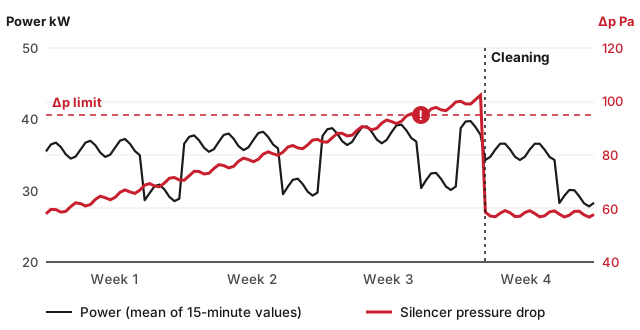
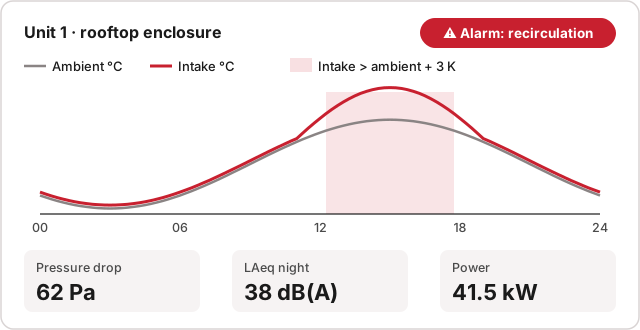
Example illustrations – not measured data from a real unit.
Example calculationWhat unnoticed extra pressure and recirculation cost
Fouled silencers
- Air flow 60,000 m³/h, pressure drop rises by 40 Pa
- Additional air power: 667 W
- At 50 % overall fan efficiency: 1.33 kW electrical
- 3,000 operating hours per year
≈ 1,000 € per year at €0.25/kWh
Recirculation of warm exhaust air
- Electrical power of the unit 100 kW, 3,000 operating hours per year
- Intake air on average 2 K warmer than ambient
- Rule of thumb: approx. 2.5 % efficiency loss per kelvin
≈ 3,750 € per year at €0.25/kWh
Example calculation with typical assumptions, not project data. With your unit data we calculate it specifically.
From basic monitoring to the ATEX solution
| Package | Measured variables | Typical use |
|---|---|---|
| Basic | Intake, exhaust and ambient temperature; silencer differential pressure | Heat pumps, VRF outdoor units, PV inverters |
| Performance | as Basic, plus air velocity, air flow, recirculation detection and power load profile | Chillers, dry coolers, data centres |
| Refrigerant | as Performance, plus infrared leak sensors (NDIR) for HFC/HFO and CO₂ | Units with F-gases, commercial refrigeration, battery storage with chiller |
| ATEX | as Refrigerant, with Ex sensors for R290, connection to the gas warning controller and alarm reporting | R290 heat pumps and chillers in acoustic enclosures |
| Sound option | continuous sound monitoring LAeq/LAFmax, day/night, on the enclosure and/or at the receiver point – with any package | Residential and spa areas, night operation, units with complaints |
| Energy option | power load profile added to the Basic package | Energy management, evidence for operators |
All packages are also available as a retrofit for existing enclosures. Measuring concept, zoning and alarm thresholds are defined per project with the operator and the refrigeration contractor. Price with the quotation.
Also available in the configurator
For heat pumps, chillers and dry coolers, and in the large-unit catalogue, you can request IoT monitoring together with the enclosure – tick the measured variables, with ATEX design for R290.
From enquiry to ongoing monitoring
Enquiry
Unit, enclosure, refrigerant, goal
Measuring concept
Measuring points, zone, interfaces
Delivery
Sensors and gateway pre-configured
Installation
With the enclosure or as a retrofit
Commissioning
Limits, alarm routes, reference values
Operation
Dashboard, reports, condition-based maintenance
With this information we can answer fastest
- Manufacturer, unit type, quantity
- Refrigerant and charge
- New enclosure or retrofit
- Required measured variables, sound measuring point
- Hazardous zone per explosion protection document
- Existing gas warning system
- Building management system, protocol, existing energy meters
- LAN or cellular at the site
- Alarm recipients (operator, service)
Frequently asked questions
Why LoRaWAN rather than Wi-Fi or a cellular modem per sensor?
LoRaWAN sensors transmit over long distances with very little energy and therefore run for years on one battery. The 868 MHz signal gets out of enclosures with ventilation openings much better than Wi-Fi; if necessary, the antenna is routed outside. One gateway serves many sensors, and the network is independent of the customer’s IT network.
Does IoT monitoring replace the gas warning system?
No. With R290 and other refrigerants for which gas detection is required, the hard-wired gas warning controller with shutdown remains the safety function. Radio monitoring adds remote reporting, trends and documentation.
Does continuous sound monitoring replace a statutory noise measurement?
No. Legally binding measurements (in Germany to TA Lärm) are carried out by an officially recognised measuring body. Continuous monitoring serves operational supervision: it shows trends, makes night operation and full load visible and provides data in the event of complaints.
Do the sound sensors record conversations?
No. The sensors only calculate sound levels inside the device and transmit values such as LAeq and LAFmax. No audio is stored or transmitted.
How is power consumption measured?
If an energy meter with a Modbus, M-Bus or S0 interface is present, we read it via a LoRaWAN converter. Otherwise split-core current transformers are retrofitted in the control cabinet – by a qualified electrician. A load profile in 15-minute values is transmitted.
Who owns the measured data?
The operator. The network server can run on the operator’s premises or be hosted in the EU. Radio transmission is encrypted with AES-128 according to the LoRaWAN standard.
Does this open a door for cyber attacks?
The sensors only measure and do not intervene in the unit’s controls; the connection to the building management system is read-only. Background on the risks of connected units: The heat pump as a gateway.
Does leak detection help with the F-gas Regulation?
The F-gas Regulation (EU) 2024/573 requires a leak detection system above certain charges and extends the inspection intervals where one is installed. Whether and how our system counts towards this is agreed per project with the refrigeration contractor.
Can existing enclosures be retrofitted?
Yes. The sensors are battery-powered and are mounted without cable penetrations in the acoustic shell. In hazardous zones, only devices approved for the defined zone are used.
Request IoT monitoring
Unit, refrigerant and the variables you want to measure are enough to start – also for retrofitting existing enclosures. You will receive a measuring concept with a quotation.
We usually get back to you within 2–3 working days.
- Review of your details – with a short question on measuring points, hazardous zone and BMS if needed
- Measuring concept with sensors, gateway, interfaces and alarm routes
- Quotation for delivery, installation and commissioning – sensors and gateway pre-configured
Brands ForCoTech and Silent-Mode
Via Trento 22 · 23875 Osnago (LC) · Italy
Email: info@forcotech.com
Web: silent-mode.com
Prefer to size it yourself?