
Technology in detail
For designers and installers: how we engineer acoustics, air flow and construction – and why air flow decides whether an enclosure works.
HSA3 instead of conventional absorbers
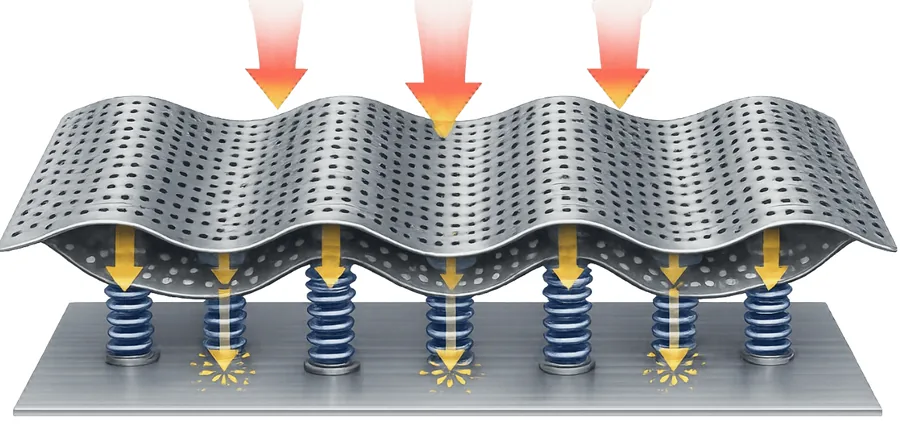
Our enclosures use HSA3 as standard, the acoustic meta-metal developed and patented by ABSORA GmbH (Berlin). Many small, periodically arranged chambers and resonators specifically damp the frequencies at which compressors and fans disturb the neighbours.
Silent Engineering is responsible for technical planning and acoustic design; manufacturing and installation are carried out in our alliance with ABSORA – design and execution from a single source, with no gaps between calculation and build.
Alternative inner lining: Stratocell® Whisper® 50 mm FR (PE foam, broadband, moisture-resistant, flame-retardant). Test report and technical documents for HSA3 on request: info@forcotech.com
How HSA3 works – in simple terms
One modular kit – from single component to full enclosure
Compressor panel
Covers the compressor compartment and reduces the typical low-frequency drone.
Fan cylinder
Kit against the tonal fan noise (blade passing frequency = number of blades × speed).
Partition wall
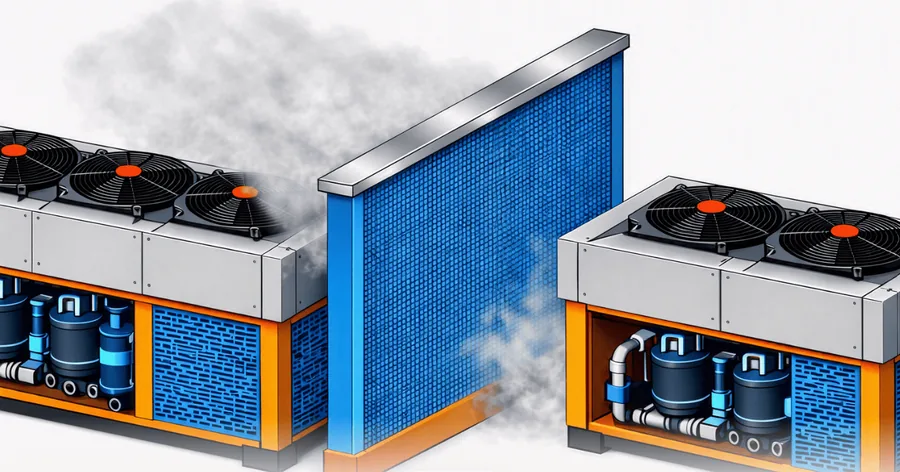
Decouples neighbouring units acoustically and in terms of airflow.
Full enclosure
For BESS, large heat pumps, dry coolers, chillers and VRF/VRV combinations.
What makes it work best
- Airtight frame – essential for low frequencies
- Place it as close to the noise source as possible
- Guide vane with 50–90° deflection or a sound cone against pulsation (approx. 3–7 dB(A))
What we avoid
- Gaps and vibrations – they cost performance and pressure
- Adhesive tape instead of sealant
- Front and rear walls parallel to the airflow
Questions about HSA3
Why does HSA3 work without mineral wool?
The micro-perforated top layer and the chambers behind it form many small resonators (Helmholtz principle). Air friction in the fine holes turns sound energy into heat. A deliberate difference in phase and sound pressure between front and rear chamber – an impedance jump – creates the absorption. The multi-layer core distributes the rest before it reaches the carrier plate. There are no fibres that soak up moisture or shed.
Why is HSA3 better than conventional insulation at low frequencies?
Porous absorbers need a lot of thickness and mass for low frequencies – and hardly reach structure-borne noise radiated by housings. HSA3 works through its geometry: locally resonant structures specifically damp the range where compressors, fans and pumps drone. The result: slimmer, lighter enclosures with less pressure drop and therefore more unit capacity.
Is HSA3 suitable for BESS and outdoor use?
Yes. HSA3 is non-combustible (class A1 to EN 13501-1, the highest classification) – especially important for battery storage. The metal is weather-resistant and designed for permanent outdoor use, where chillers and heat pumps are usually installed.
Does it always have to be a full enclosure?
No. Because HSA3 is modular, individual noise sources can be treated: the compressor, the tonal fan noise (blade passing frequency) or the whine of inverters. The modules sit close to the source, can be removed individually and save space and material compared with full cladding – ideal for retrofits.
How is the supporting structure built?
From anodised aluminium industrial profiles 45 × 45 mm with T-slot, joined with standard corner brackets and slot nuts – bolted, not welded. Every part is available from stock, so short lead times instead of one-off fabrication, with no paint line and no weld inspection. The design is proven for self-supporting frames over 12 m and originated in 2015 with the Silent-Mode and ForCoTech brands.
Why is airtightness so important?
Low frequencies find every gap. That is why we seal frames with sealant rather than tape and avoid vibrations. What is laborious in a prototype becomes reproducible in series production – and therefore standard in our custom builds too.
How does an HSA3 project run and how is the effect verified?
From a single source: acoustic design from first consultation to detail, made-to-fit manufacturing of the HSA3 components, site logistics and installation by regional, quality-assured teams – and finally an on-site (in situ) differential measurement that proves the effect.
Images: schematic illustrations.
Air flow decides where the noise goes
With air-cooled units the discussion is often only about dB(A) – not about how the unit draws in and discharges air. Yet that is exactly what decides where the noise goes and where a measure actually works.
Vertical discharge
Fan noise goes upwards, compressors radiate sideways. Critical for upper floors and taller neighbouring buildings.
Table design
Air enters from below. Part of the noise is reflected by the roof surface and escapes sideways.
Inverted table design
Discharge downwards: noise spreads flat in all directions – with a risk of air short-circuit.
Horizontal discharge
Air and noise go straight out. In front of a wall or in a corner, up to 6 dB are added.
Ducted
Only the openings radiate outwards – duct silencers are most efficient here.
AHU with heat recovery
Exhaust and outdoor air both radiate and must be separated against short-circuit.
One rule applies to all: every silencer costs pressure. If the pressure drop rises, the fan speeds up – and the noise level rises again. That is why we always design acoustics and air flow together.
Technology and design
An enclosure must never choke the equipment. That is why we design acoustics and air flow together and verify both before anything is built.
- CFD simulation of air flow and pressure drop – no flow noise, no air short-circuit thanks to separate intake and discharge chambers
- Noise calculation from sound power, distance and type of area
- BIM model for coordination with designers and site management
- Structural design and wind load to EN 1991-1-4, also for rooftop installation
- Easy maintenance: doors and removable panels for service and replacement
Target values before detailed design
- Air velocity in the free openings ideally 5–7 m/s
- Noise reduction at the receiver, e.g. 10–15 dB(A), decisive for night-time operation
- Loss of unit capacity due to the enclosure max. 3–5 %
Example: 100,000 m³/h at 5 m/s requires about 5.6 m² of free area – on both the intake and the discharge side.
Construction
Robust, modular and adaptable later on.
- Frame of anodised aluminium profiles
- Powder-coated panels in any RAL colour
- Inner lining of HSA3 (Absora technology), non-combustible A1, with resonance cavity
- Bolted, not welded – can be dismantled, reused and extended at any time (doors, maintenance walkways, sensors)
- Lightweight modules: can be carried up the stairs to the roof without a crane – ideal for retrofits
- Tube silencers in the roof for upward air discharge
- No floor and no contact with the unit – structure-borne noise is not transferred to the enclosure
Noise control for units with flammable refrigerants (R290)
An enclosure around an R290 unit is feasible – but only with written approval from the unit manufacturer and a design in which leaked propane can flow away freely at the bottom. The German BWP guideline is generally critical of enclosing a unit afterwards; it is only justifiable if the manufacturer confirms the specific solution and the installation and safety concept is updated.
Our standard design – no contact with the unit, no floor, HSA3 inner lining in class A1 – already meets the basic structural requirement. Manufacturer approval, zoning and verification of the openings are added per project.
No floor, no pit
Propane is about 1.5 times heavier than air and flows like water. The enclosure stays open at the bottom, with no sills or recesses.
No ignition sources
No lights, sockets, switches or drives inside the enclosure – unless explosion-proof for the defined zone.
Openings that cannot be closed
Ventilation and relief openings work even in storms, snow and with the fans at standstill.
Storm and relief openings
- Ground gap: free all round, minimum height agreed with the manufacturer; falls outwards, never towards light wells, drains or roof outlets. On flat roofs the parapet must not dam the outflow.
- Cross-ventilation: openings on at least two opposite sides, no motorised louvres – if needed acoustically, only fail-open and wind-pressure-proof. A manufacturer's fan purge must not be obstructed.
- Pressure relief: if an explosion zone lies inside the enclosure, relief areas to EN 14994 – the open roof air outlet is the natural relief area.
Why a closed envelope is dangerous
Propane is non-toxic but extremely flammable and heavier than air. Example: a double enclosure of 12 × 4.2 × 3.9 m (approx. 197 m³) reaches the lower explosive limit with only about 7.5 kg of propane evenly distributed – and locally much sooner as it layers at the bottom. Large heat pumps contain several times that amount.
Conflict with acoustics
Every ground opening is a sound bridge. Our solution: a surrounding acoustic skirt set at a distance, or a shallow labyrinth lined with HSA3 – always falling outwards. We check air flow and gas outflow with CFD.
Checklist for planning, installation and operation
Planning
- Written approval of the unit manufacturer for the enclosure
- Safety zone and refrigerant charge taken from the manufacturer's documentation
- Zoning defined by operator or expert (explosion protection document)
- Safety zone does not reach neighbouring plots, paths, car parks or building openings
- No light well, drain or roof outlet in the outflow path
- Ground openings on at least two sides, cross-section agreed with the manufacturer
- CFD verification of air flow, wind influence and gas outflow
- Relief areas to EN 14994 if a zone lies inside the enclosure
Installation
- Enclosure without floor, no contact with the unit
- No plinths, sills or trays; falls outwards
- Electrical equipment only explosion-proof for the zone
- Enclosure frame bonded to equipotential bonding (agreed with electrical design)
- No louvres in storm openings, or only fail-open and wind-pressure-proof
- Inner lining A1 (HSA3), absorbers at least B1
- Marking: flammable refrigerant, no ignition sources
Operation and maintenance
- Check ground and storm openings for leaves, snow and objects at every service
- No storage in or next to the enclosure
- Work on the refrigerant circuit only with a gas detector and spark-free tools
Request a project
Send us the unit type, quantity and location – or get a budget price straight from the configurator.
ForCoTech · Silent-Mode
Via Trento 22 · 23875 Osnago (LC) · Italy
E-Mail: info@forcotech.com