Noise control that also cools – adiabatic pre-cooling in the acoustic enclosure
On hot days, the adiabatic module pre-cools the intake air of chillers by approx. 6–9 K. Fewer high-pressure trips, more capacity – and quieter, because the fans can run slower.
On hot days, everything comes together
Air-cooled chillers work at their limit when the outdoor air is at its warmest. That is exactly when the fans run at full speed – and the unit is at its loudest.
- High pressure: At 35 °C and above, condensing pressure rises. The unit throttles back or trips on fault.
- Capacity: Cooling capacity and efficiency drop just when demand is highest.
- Noise: Full fan speed means the highest sound level, often on warm summer nights too.
- Space: There is usually no room left on site for a separate pre-cooling system.
The enclosure pre-cools the intake air
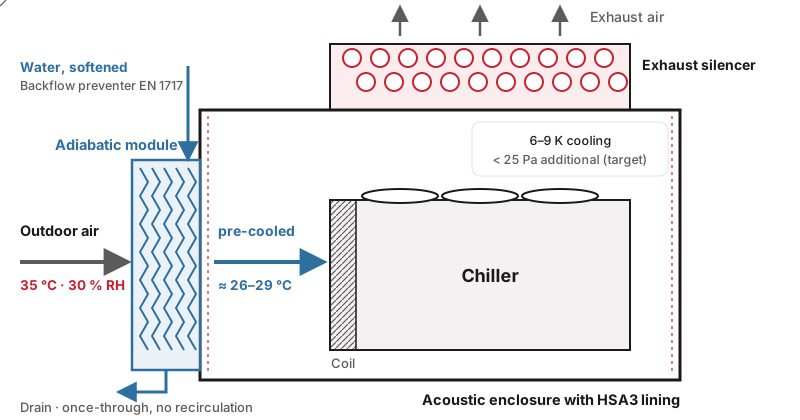
The acoustic enclosure already guides the air through a defined intake area. That is where the adiabatic module sits: water evaporates on a wetted surface and draws heat from the incoming air before it reaches the unit’s coil.
Cooling without refrigerant
Evaporating water lowers the air temperature. At 35 °C and 30 % relative humidity, approx. 6–9 K of cooling is possible.
Once-through, no spray nozzles
Water runs over the evaporation surface once: no recirculation, no standing water, no spray mist.
Matched to the enclosure
We design acoustics, air flow and adiabatic cooling together. Target for the additional pressure drop: below 25 Pa.
Air flow →Noise control that also cools
Operational reliability
Lower risk of high-pressure shutdowns on hot days.
Capacity reserve
More cooling capacity and efficiency when you need it.
Quieter in the heat
Cooler air allows lower fan speeds.
All from one source
Enclosure and adiabatic cooling designed together – new or retrofitted.
Applications
Guide and target values
| Intake air cooling | approx. 6–9 K at 35 °C / 30 % RH |
| Saturation efficiency | 45–65 % (under test) |
| Additional pressure drop | < 25 Pa (target) |
| Water demand (evaporation) | approx. 4.7 l/h per 10,000 m³/h of air and K of cooling |
| Operating mode | Once-through, no recirculation, no spray nozzles |
| Water quality | softened or partially demineralised |
| Materials | HSA3 (class A1), MiniTec 45×45, seawater-resistant aluminium in the wet zone |
| Water connection | Mains water via backflow preventer to EN 1717 |
Worked example
Guide and target values, development status 2026, subject to technical changes. The gain in cooling capacity and efficiency depends on the unit and is calculated for each project. We check the hygiene and regulatory requirements for evaporative systems (e.g. German 42nd BImSchV, VDI 2047) for every project.
Test the adiabatic module on your installation
For the trial phase we are looking for operators and consultants with air-cooled chillers that reach their limits on hot days – as a new enclosure or as a retrofit to an existing one. The measurement data and the installation remain yours: we never publish names or locations without your consent.
With this information we can check suitability quickly
- Manufacturer, model, quantity
- Air flow and pressure reserve
- New enclosure or retrofit
- Problems on hot days (high pressure, capacity)
- Noise target and assessment point
- Operating hours, including at night
- Water supply and drain on site
- Layout plan and space on the intake side
- Preferred trial period
Frequently asked questions
How much water does the adiabatic module use?
Around 4.7 litres per hour per 10,000 m³/h of air and kelvin of cooling. Because the module only runs on hot days, annual consumption remains moderate.
Does it create spray mist or aerosols?
The module works without spray nozzles and without recirculation: water runs over the evaporation surface once and drains away. We check the hygiene requirements for every project.
What water is required?
Softened or partially demineralised water, connected to the mains via a backflow preventer to EN 1717.
Does the module cost cooling capacity?
We design enclosure and adiabatic module so that the additional pressure drop stays below 25 Pa (target). On hot days, the gain from cooler intake air clearly outweighs it.
Can the module be retrofitted?
Yes. The adiabatic module is intended both for new acoustic enclosures and for retrofitting existing ones.
When will the module be available?
The module is currently under test. We are looking for pilot users – get in touch.
Request a project
Send us the unit type, quantity and location – or get a budget price straight from the configurator.
ForCoTech · Silent-Mode
Via Trento 22 · 23875 Osnago (LC) · Italy
E-Mail: info@forcotech.com