
Main noise sources in air-cooled heat pumps and chillers
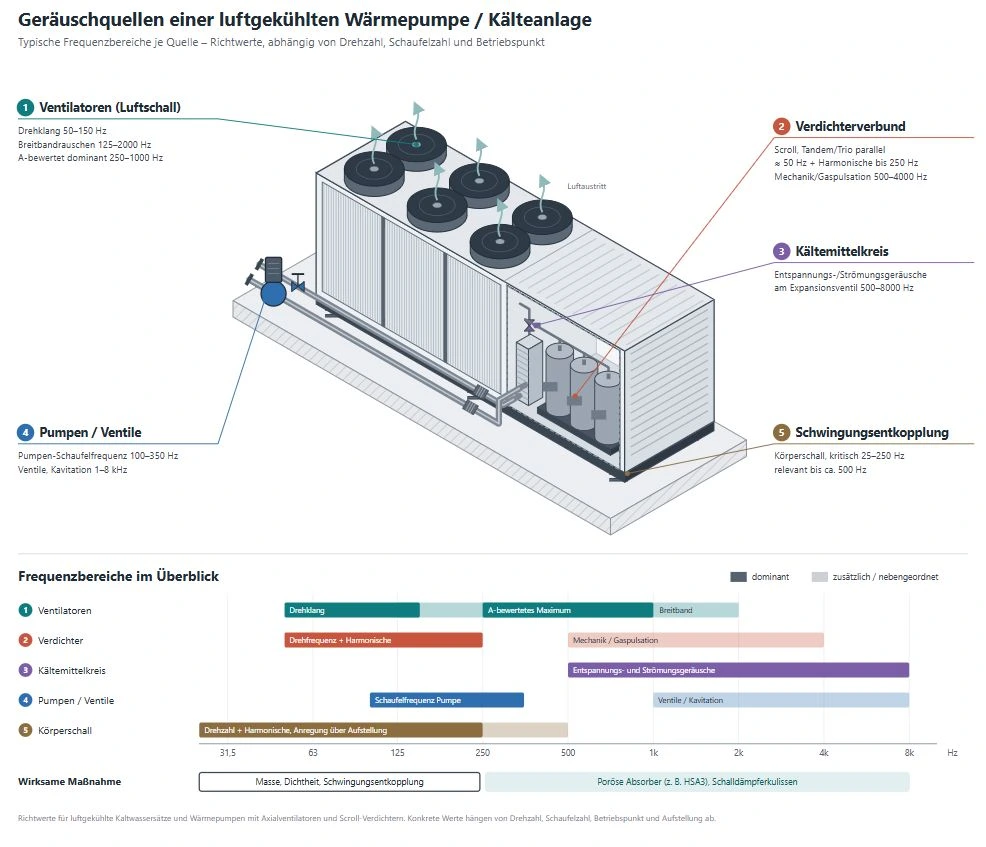
Air-cooled heat pumps and chillers have five main noise sources. They differ above all in their frequency range – and that decides which noise control measure works.
1. Fans – usually the loudest source
Axial fans produce a tonal rotational sound at around 50–150 Hz and broadband flow noise from 125 to 2000 Hz. A-weighted, they dominate between 250 and 1000 Hz. Because they radiate openly upwards and move large volumes of air, they usually determine the overall level. Effective measures are splitter silencers in the air path and enclosures with absorbent lining – always keeping an eye on the pressure drop.
2. Compressor sets – low and mid frequencies at once
Scroll compressors in tandem or trio sets produce the rotational frequency around 50 Hz with harmonics up to about 250 Hz, plus mechanical noise and gas pulsation between 500 and 4000 Hz. With speed-controlled compressors the low-frequency component shifts with the speed. The low frequencies need mass and airtightness of the enclosure; the mid and high frequencies are captured well by absorbers.
3. Refrigerant circuit – high-frequency, but noticeable
Expansion and flow noise at the expansion valve lies at 500–8000 Hz. It contributes little to the overall level but is clearly perceived as hissing. Porous absorbers damp this range very effectively.
4. Pumps and valves – often underestimated
Depending on speed and number of blades, the blade passing frequency of pumps lies at 100–350 Hz. Valves and cavitation create noise in the kHz range. The critical point is transmission through the pipework: expansion joints and decoupled pipe routing matter more here than the enclosure itself.
5. Structure-borne noise – a transmission path, not a source
An insufficiently decoupled installation transmits the vibrations of compressors and fans into the roof or building – critical at 25–250 Hz and relevant up to about 500 Hz. No enclosure can fix this. What is needed are correctly designed vibration isolators whose natural frequency lies well below the excitation frequency, plus flexible connections.
Conclusion
The A-weighted level is usually determined by fans and compressors in the 250–2000 Hz range – exactly where absorbers such as HSA3 and splitter silencers work best. The low-frequency remainder below 250 Hz can only be controlled through mass, airtightness and clean vibration isolation. An effective solution therefore always combines both approaches.
Originally published in German on silent-mode.com