Noise barrier + exhaust silencer – more reduction, no enclosure
A noise barrier screens the side radiation, the silencer on the unit reduces everything leaving at the top through the fans. Together they close the gap between barrier and enclosure – unit freely accessible, open at the top, only a few pascals of pressure drop.
A barrier is not enough, an enclosure is too much
A noise barrier typically achieves 6–10 dB(A), an enclosure 15–25 dB(A). Many projects fall in between: the limit is exceeded by 10–15 dB(A), but an enclosure does not fit – because of space, service access, appearance or R290.
- Barrier alone: for more than 10 dB(A) it has to become very high – structure, wind load and planning permission become an issue.
- Enclosure: works in all directions, but changes air flow, access and installation.
- Combination: the barrier stays moderately high, the silencer on the unit takes care of the exhaust path. The unit stays open at the top and accessible from all sides.
Two sound paths – two measures
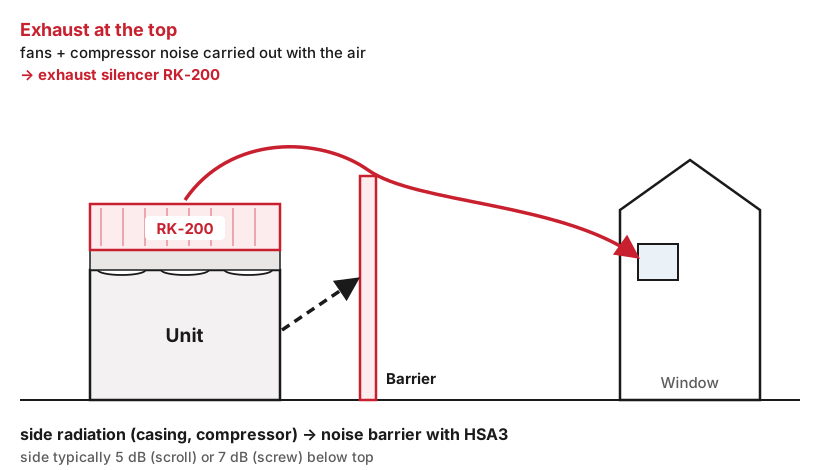
A heat pump or chiller radiates sound along two paths. What matters is not where the sound comes from, but where it goes.
Exhaust through the fans
Fan noise – and a large part of the compressor noise carried out with the air through coil and fans. This path is reduced by the exhaust silencer RK-200 of HSA3 tubes.
Casing and compressor
Compressor noise radiated directly through panels and fins – low-frequency and often tonal. This path is screened by the noise barrier with HSA3 absorber.
How loud is the side?
From our projects: side typically 5 dB below top for scroll and 7 dB below top for screw compressors. With manufacturer data per side we calculate more precisely.
The barrier must reach above the line of sight from silencer to window
The silencer raises the exhaust outlet by frame and silencer height. If the barrier edge lies below the line from the outlet to the window, the exhaust path is hardly screened – it then determines the result, however well the barrier works at the side.
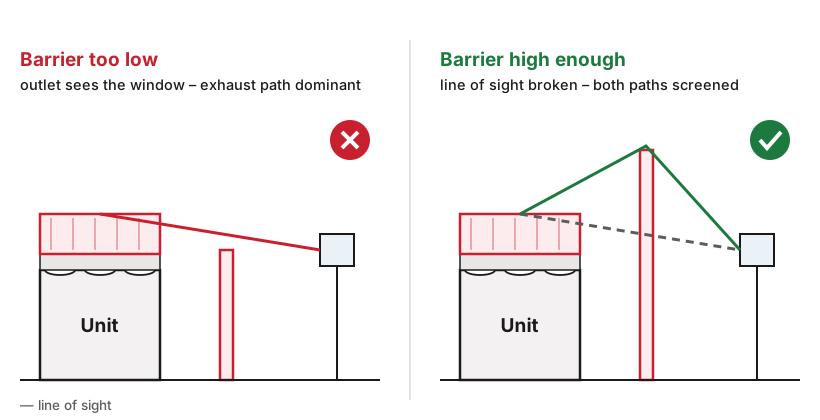
- Outlet height = unit height + transition frame (guide value 500 mm) + 1.0 m silencer.
- High windows close to the unit need a higher barrier – or the 45° top return that tilts the edge towards the unit.
- The configurator checks this automatically and shows which path is dominant and which barrier height is sufficient.
One example calculated
Air-cooled chiller 4.9 × 2.24 × 2.4 m, sound power LWA 92 dB(A), scroll compressors. Window on the first floor (5 m high) 25 m behind a U-shaped noise barrier, general residential area, night limit 40 dB(A) (TA Lärm, Germany). Sample without customer reference.
| Option | Level at the window | Result |
|---|---|---|
| no measure | 55.3 dB(A) | 15 dB above the limit |
| barrier 3.0 m only | 49.2 dB(A) | not sufficient – alone approx. 5.4 m would be needed |
| exhaust silencer only | approx. 50 dB(A) | not sufficient – the side radiation remains |
| barrier 3.0 m + silencer | 43.2 dB(A) | outlet at 3.9 m lies above the barrier – exhaust path dominant |
| barrier 4.0 m + silencer | 39.6 dB(A) | limit met (by calculation from approx. 3.8 m) |
| for comparison: enclosure (typically −20 dB(A)) | approx. 35 dB(A) | more reserve, but a closed enclosure |
Estimate to DIN ISO 9613-2 and TA Lärm as in the configurator (calculation status October 2026): screening of both paths at 250 Hz, silencer with the lower value of the expected reduction. Does not replace a noise immission forecast.
Barrier, combination or enclosure?
| Noise barrier | Barrier + silencer | Enclosure | |
|---|---|---|---|
| Typical reduction | 6–10 dB(A) towards the screened side | approx. 10–16 dB(A) towards the screened side | 15–25 dB(A) in all directions |
| Air side | open at the top, no pressure drop | open at the top, approx. 4–8 Pa | designed for air flow and pressure |
| Service | freely accessible | freely accessible, silencer on top | via doors and panels |
| R290 (propane) | uncritical | uncritical, all-metal and earthed | open at the bottom only, with manufacturer approval |
| High windows, several sides | effect decreases | effect decreases | also works upwards |
| Well suited when … | the limit is exceeded only slightly | 10–15 dB(A) are missing and an enclosure does not fit | several sides are affected or a lot of reduction is needed |
What is calculated – and what is being measured
HSA3 absorber
Sound absorption in the reverberation room to ISO 354 – the basis for barrier and tubes.
Measured values →Silencer RK-200
Pressure drop and module sizing calculated; insertion loss per octave estimated. The test to DIN EN ISO 7235 on the prototype is in preparation.
Your installation
Top/side split, spectrum and geometry are checked for every project – with your data sheet.
Frequently asked questions
When is a noise barrier alone sufficient?
When only one side is affected and the limit is exceeded by up to about 10 dB(A). Beyond that the barrier has to become so high that structure, wind load and appearance become difficult – then the additional silencer pays off.
Why does the silencer also reduce compressor noise?
A large part of the compressor noise is carried upwards with the air through coil and fans. Everything leaving at the top passes through the silencer tubes – whether it comes from the fan or the compressor. What radiates sideways through the casing is handled by the barrier.
How high must the barrier be?
High enough to break the line of sight from the silencer outlet to the relevant window. The outlet lies at unit height plus transition frame plus 1.0 m. The configurator calculates the recommended barrier height for your geometry.
How large is the additional pressure drop?
Designed for max. 5 m/s in the tubes, the silencer RK-200 has around 4–8 Pa. The barrier itself adds no pressure drop as long as the clearance to the unit is kept (at least 800 mm recommended).
Is the combination suitable for R290 units?
Yes. The barrier is open, propane can disperse freely. The silencer is all-metal without insulating linings, conductive throughout and earthed via the frame. The manufacturer's safety zone still applies.
Are the attenuation values measured?
The absorption of HSA3 is measured in the reverberation room. The insertion loss of the silencer RK-200 is estimated so far and will be measured on the prototype to DIN EN ISO 7235. On this page and in the configurator we therefore use the lower value.
When is an enclosure the better choice?
When several sides or high windows close to the unit are affected, when more than about 15 dB(A) are missing or when the unit discharges sideways. An enclosure then works in all directions and with more reserve.
Request a project
Unit, quantity and location are enough to start – with a data sheet we can check dimensions, air volume and sound power straight away. For complex projects you will usually receive a binding quotation within 2–3 days; custom enclosures are usually delivered 40–60 days after order.
We usually get back to you within 2–3 working days.
Brands ForCoTech and Silent-Mode
Via Trento 22 · 23875 Osnago (LC) · Italy
Email: info@forcotech.com
Web: silent-mode.com
Prefer to size it yourself?