Engineering experience meets AI: how we work with Claude
Artificial intelligence has been part of our work since its early days. Today we work directly with Claude, an AI model by Anthropic, every day. Here we show how this collaboration works in practice, what it delivers and where its limits are.
Our path to AI
We were among the early users of Perplexity and, from the start, worked there mainly with the Claude models: for research on standards and manufacturer data, for technical questions and for writing. Over time we compared different models and learned where AI really helps and where you need to look closely.
The big step came when we started working with Claude directly. Since then, the AI no longer just researches, it works alongside us: it calculates designs, produces drawings, writes quotations and develops our software.
A clear division of tasks
Our acoustic enclosures are built on more than ten years of project experience. That knowledge remains the core. Who does what is clearly defined:
- We contribute experience, manufacturer data, sketches and site knowledge, and we make every decision.
- Claude calculates, draws, writes, programs and checks – quickly, thoroughly and at any time of day.
For us, Claude is not a machine that spits out ready-made solutions. It works like a very fast colleague with whom we develop a solution in dialogue.
How a quotation is made
A typical enquiry arrives with a data sheet, an item from a bill of quantities or a hand sketch. A quotation follows in a few steps:
- Read and understand: Claude reads the documents and summarises dimensions, air flows, refrigerant and acoustic requirements.
- Propose a design: Claude determines the air velocity (v = V̇/A), the pressure drop (Δp = ζ · ρ/2 · v²), the surfaces and the enclosure build-up according to our standard construction, and shows all calculations openly.
- Draw: Claude produces isometric views and elevations, large and easy to read.
- Correct: We check everything against manufacturer drawings and our experience. This is where the important decisions are made.
- Finalise: The quotation is produced in our standard layout, with traceable engineering and a price list.
An example from practice: for a school project with four heat pumps in cascade, we started with individual enclosures. Over several rounds these became compact double enclosures and finally a walk-in enclosure with a service corridor. Because of the R290 refrigerant, a gas detection system was added. Each round took hours instead of days.
Software we develop ourselves
Together with Claude we built tools in a few weeks that would once have required a software team:
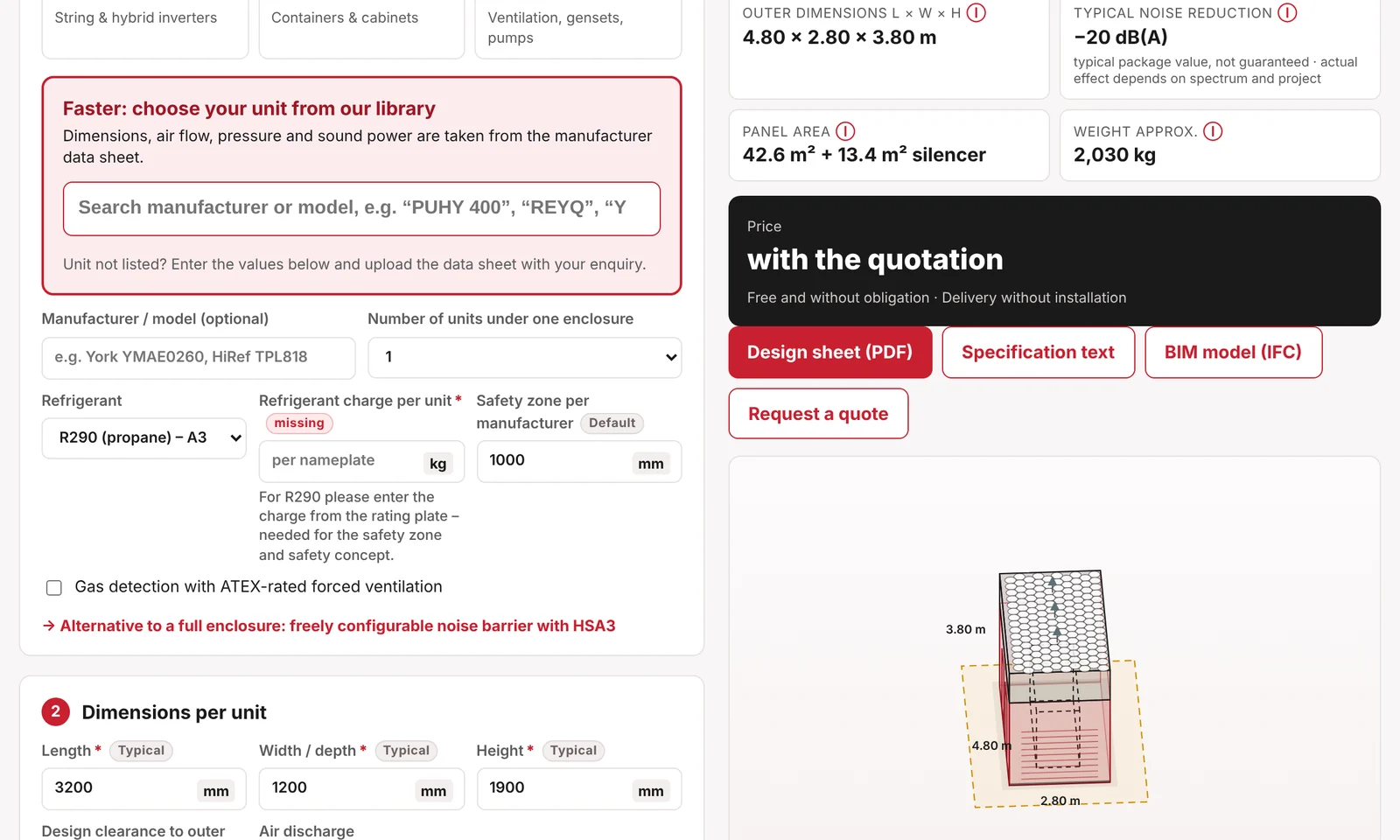
- the online configurator in three languages, with checks according to TA Lärm (German noise regulations), air-flow and pressure-drop check, R290 safety functions, wind load calculation and 3D view,
- an equipment library with manufacturer data from leading brands,
- this website with all product and news pages.
Fixed rules apply to the software. Every change is automatically checked and versioned. Nothing goes live without our approval, and the data is backed up regularly.
Where the limits are – and why that is a good thing
AI makes mistakes. Once Claude proposed an R290 safety option for VRF outdoor units, although these units run on R32. Such things are caught because, in the end, an engineer who knows the equipment checks the result. That is why our rules are:
- Responsibility stays with people. Every design and every quotation leaves only after our review.
- Calculations are traceable. Formulas and assumptions are stated openly in the quotation.
- Data protection comes first. We do not publish customer data, project names or locations.
What our customers gain
- Faster answers: binding quotations for complex projects usually within 2–3 days
- Transparent engineering with open calculations instead of blanket statements
- Preliminary design around the clock in the configurator
- Proven execution with HSA3 technology by ABSORA
Our conclusion
Working with Claude has changed the way we work. We have not become less thorough – we have become faster and more consistent. The experience from more than 500 projects no longer lives only in people's heads, but also in tools that get better every day. And honestly: it is great fun.