
Noise control for BESS and R290: where mineral wool and foam reach their limits
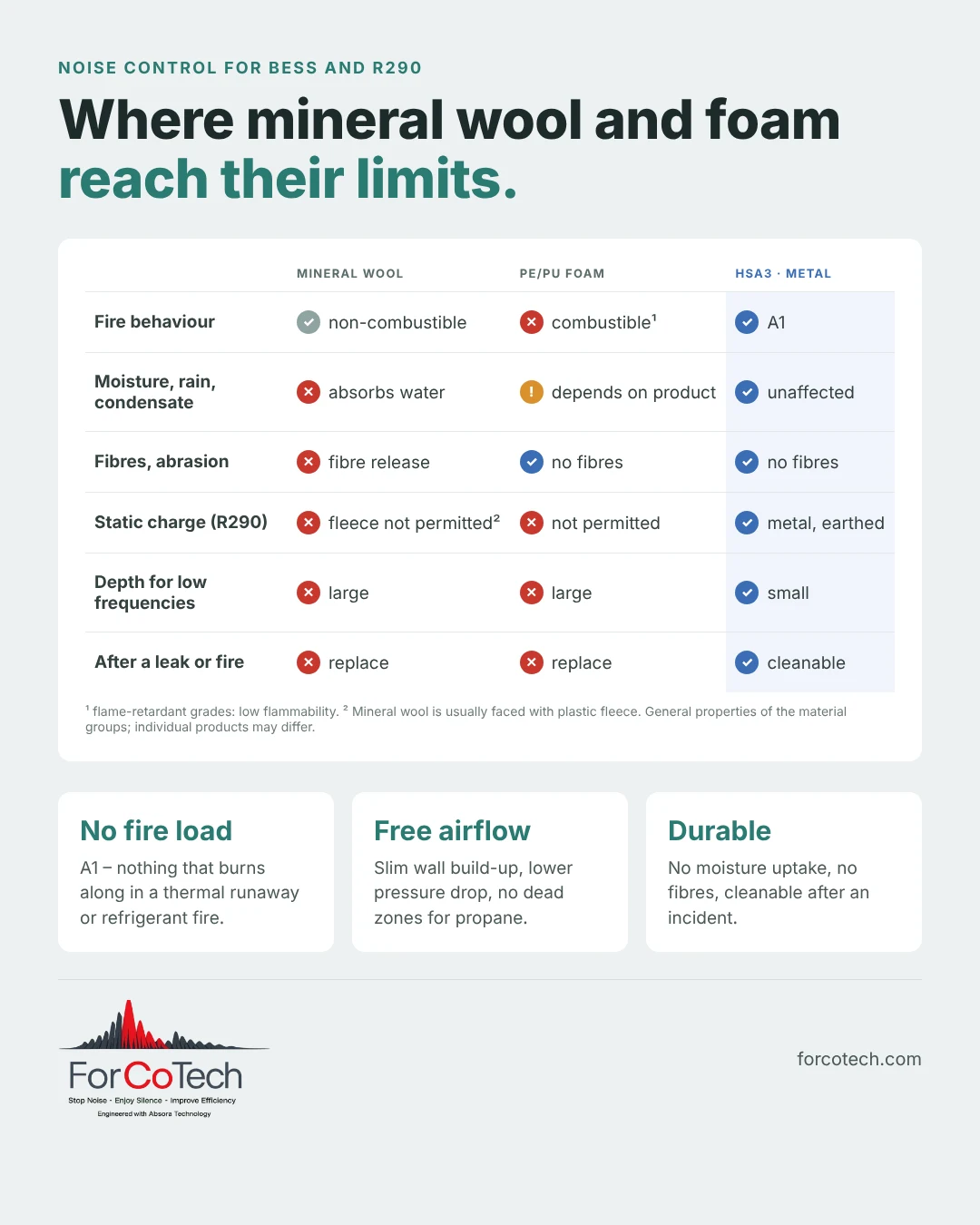
Battery energy storage systems (BESS) and heat pumps using propane (R290) place different demands on an acoustic enclosure than conventional plant. Besides sound insulation, fire load, ignition sources, free airflow and durability all count. This is exactly where absorbers made of mineral wool or plastic foam reach their limits.
ForCoTech enclosures therefore use HSA3: a metal absorber developed by our partner ABSORA, with no fibres and no foam.
1. No additional fire load
HSA3 is non-combustible (A1 to EN 13501-1). The enclosure adds no material close to the unit that could burn along in an emergency.
- Plastic foams based on PE or PU are organic and therefore combustible; flame-retardant grades have low flammability. In a fire they can melt and release smoke gases.
- With BESS, thermal runaway of a single cell can start a fire. A combustible absorber inside the enclosure makes it worse.
- With R290, a refrigerant leak followed by ignition can cause a secondary fire in the enclosure.
- Mineral wool is also non-combustible depending on the product, but has other weaknesses (section 4).
Fire safety experts and property insurers increasingly require non-combustible materials around battery storage and flammable refrigerants.
2. R290: free airflow, no ignition sources
Propane is heavier than air. In the event of a leak, no ignitable concentration may build up inside the enclosure.
- Thick absorber layers narrow the free cross-sections and create dead zones where gas can linger.
- Plastic foams and the plastic fleeces usually laminated onto mineral wool are insulating and therefore chargeable under the German rule TRGS 727. Electrostatic discharges are an ignition source, so such materials have no place within the safety zone of an R290 unit.
- HSA3 is metal, can be earthed throughout and builds slim. Our enclosures have no floor and flow openings in the profiles, so leaking refrigerant drains freely downwards.
We only enclose an R290 unit with the manufacturer’s approval. More on our technology page.
3. Slim build-up: lower pressure drop, more effect at low frequencies
HSA3 works with a resonance cavity of only 44 mm. Porous absorbers, by contrast, need a lot of depth to deal with low frequencies.
- Lower pressure drop: In a comparison measurement by ABSORA, an HSA3 silencer reached 73.9 instead of 74.9 dB(A) at 12 instead of 20 Pa pressure drop compared with a mineral-wool splitter.
- Thermal safety: BESS cooling and heat pumps are sensitive to a lack of air. Free cross-sections avoid derating and high-pressure trips.
- Low frequencies: Inverters and transformers hum at 100 Hz and its multiples; compressors produce low-frequency components. HSA3 is tuned specifically to this range.
- Compact enclosures: Thinner walls save space on the roof and on site.
4. No moisture, no fibres, no ageing
Outdoor plant is exposed to rain, condensate, defrost water, UV and temperature cycles. HSA3 absorbs no moisture, sheds no fibres and can be cleaned.
- Mineral wool soaks up water. It then loses absorption, gets heavy and promotes corrosion of the substructure.
- Fibre release: At high air velocities fibres come loose. They end up in filters, heat exchangers and the cooling air of electronics and batteries.
- Plastic foams age under UV and temperature cycles and collect dust and oil in their pores.
- HSA3 is so resistant that we even wet it permanently with water in our adiabatic pre-cooling.
5. Back in service after an incident
After a refrigerant leak or a battery incident, porous absorbers are contaminated with oil, electrolyte or smoke residue and have to be replaced. HSA3 surfaces can be cleaned and reused. That shortens downtime and lowers follow-up costs.
At a glance
| Property | Mineral wool | Foam (PE/PU) | HSA3 (metal) |
|---|---|---|---|
| Fire behaviour | non-combustible, depending on product | combustible, low flammability as FR grade | A1, non-combustible |
| Moisture, rain, condensate | absorbs water | depends on product | unaffected |
| Fibres, abrasion | fibre release possible | no fibres | no fibres |
| Static charge (R290) | usually faced with plastic fleece – not permitted in the R290 safety zone | insulating, chargeable under TRGS 727 – not permitted in the R290 safety zone | metal, earthed throughout |
| Depth for low frequencies | large | large | small, 44 mm resonance cavity |
| Pressure drop in splitters | reference | comparable | up to 40 % lower |
| After a leak or fire | replace | replace | cleanable, reusable |
General properties of the material groups; individual products may differ. Pressure drop: comparison measurement by ABSORA GmbH.
How a ForCoTech enclosure is built
- Load-bearing frame of anodised aluminium profiles, modular and prefabricated in the workshop
- Outer panels of 1.5 mm powder-coated aluminium; near the coast entirely in seawater-resistant aluminium
- Inner lining of HSA3 with resonance cavity, no mineral wool and no foam
- No floor, built around the unit without contact, with flow openings in the profiles
- Exhaust air through HSA3 tube silencers, designed for a maximum air velocity of 5 m/s
- Every project designed with CFD and BIM
Planning a battery storage system or an R290 heat pump?
Send us the unit data and your acoustic requirement at info@forcotech.com. You will usually receive a binding quotation within 2 to 3 days. More on our solutions: Inverters & BESS.