
Noise barriers for outdoor equipment – when an enclosure does not fit
No room for an enclosure, access needed from all sides or only one neighbour affected? Then an absorbing noise barrier is often the simpler solution. 6 to 10 dB(A) is often enough to meet the limits.
When a noise barrier is the better choice
An acoustic enclosure damps in all directions and achieves the highest values. A noise barrier screens only one side – but the unit stays open at the top, there is no pressure drop and it remains accessible from all sides.
| Noise barrier (Wall-Series) | Acoustic enclosure | |
|---|---|---|
| Typical reduction | 6–10 dB(A) towards the screened side | approx. −15 to −25 dB(A) in all directions |
| Air side | open at the top, no pressure drop | designed for air volume and fan pressure |
| Upper floors | effect decreases with window height | works upwards too |
| Service | unit freely accessible | via doors and removable panels |
| R290 (propane) | uncritical, gas flows away freely | only floorless and with manufacturer approval |
| A good fit when … | one neighbour on one side is affected and the limit is only slightly exceeded | several sides or higher windows are affected and a large reduction is needed |
Interrupting the direct path
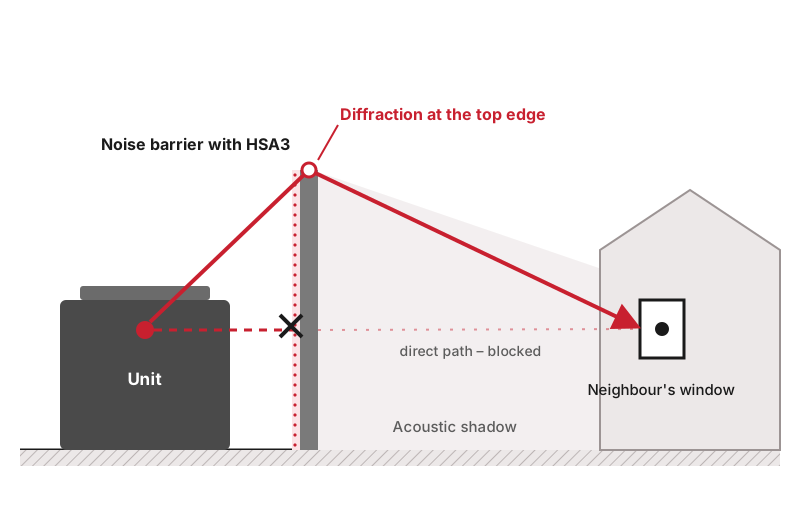
A noise barrier works as soon as it breaks the line of sight between the unit and the window. Sound then has to travel over the top edge – it is diffracted and loses energy. The longer this detour, the greater the screening.
- Close to the source: A barrier close to the unit screens more than one halfway between unit and neighbour.
- Height matters: The barrier must rise well above the sound source. A cantilever inclined 45° towards the unit increases the effect without building the wall higher.
- Absorbing, not reflecting: HSA3 on the unit side stops the barrier from throwing sound to the other side or back onto the unit.
- Extend beyond the ends: Otherwise sound simply travels around the ends of the barrier.
What a barrier can achieve
- Line of sight just interrupted: around 5 dB
- Typical for units in residential settings: 6–10 dB(A)
- Theoretical limit to ISO 9613-2 for diffraction over one edge: 20 dB
Much more than 10 dB(A) requires tall barriers close to the unit – at that point an enclosure is usually the more economical solution.
What we need for the design
- Dimensions and discharge direction of the unit
- Sound power from the data sheet
- Distance and height of the relevant window
- Area type (e.g. general residential area)
Built like our enclosures
Any shape
Straight, L-shaped, U-shaped or freely planned with up to eight segments and 45° or 90° bends. Segments over 3 m are divided into modules of equal width.
HSA3 absorber
HSA3 lining with resonance cavity, non-combustible A1 – on the unit side, or on both sides if reflections are a problem on the other side too.
Top edge
Straight or with a 45° cantilever (500 mm) that tilts the top edge towards the unit.
Structure
Base frame of anodised aluminium profiles 45 × 45 mm, panels of 1.5 mm aluminium, powder-coated. Braced with cross members on three-sided walls.
Wind load
Designed to EN 1991-1-4 for wind zone, terrain and height of the installation surface – on the ground and on flat roofs.
Doors and colour
Service doors in the barrier possible, colours RAL 7016, 9006, 7035 or special RAL.
Configure the barrier and check its effect
Enter unit and layout: the configurator calculates the screening to ISO 9613-2, checks the limits, recommends the barrier height and calculates the wind load. The quotation is available on request.
Frequently asked questions
How high does the noise barrier need to be?
High enough to reliably break the line of sight between the sound source and the relevant window – with a margin. If the window is on an upper floor, the barrier has to be correspondingly higher. The configurator suggests the barrier height for your situation.
Is a barrier enough for a neighbour on the second floor?
Often not. The higher the window, the less a barrier on the ground screens. In that case an enclosure with a tube silencer in the roof is usually the better solution.
Does the barrier restrict the unit's air flow?
No, as long as the distance to the unit is kept. The barrier is open at the top; we agree the distance based on the unit's air side so that no exhaust air is drawn back in.
Why absorbing and not just a solid wall?
A hard wall reflects sound – onto the unit, onto facades opposite or towards other neighbours. With HSA3 on the unit side, the sound is absorbed instead of redirected.
Is there a fixed price?
We design noise barriers individually. The configurator shows dimensions, effect and wind load instantly; you receive the price with the quotation.
More solutions
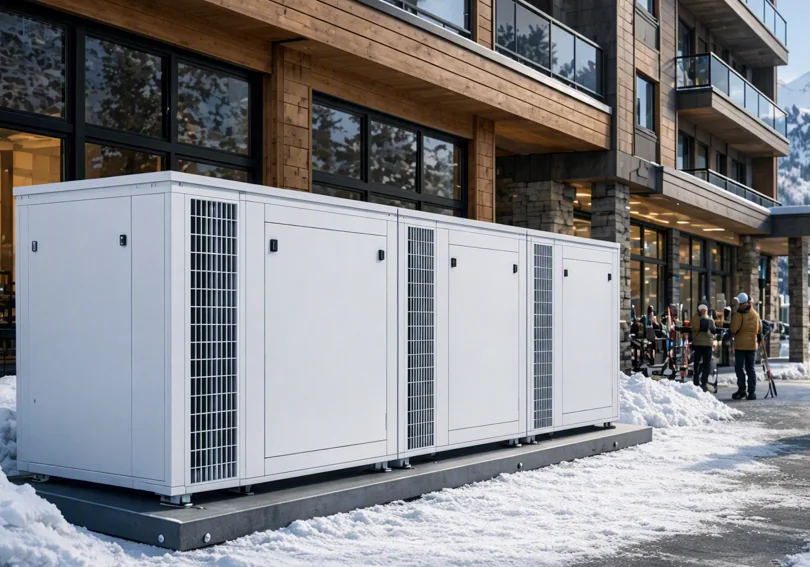 H-Series · small units
Heat pumps & air conditioning
Air-to-water heat pumps, split and AC units, pool heat pumps. Standard sizes H1–H12 or custom-made, up to −25 dB(A).
View solution →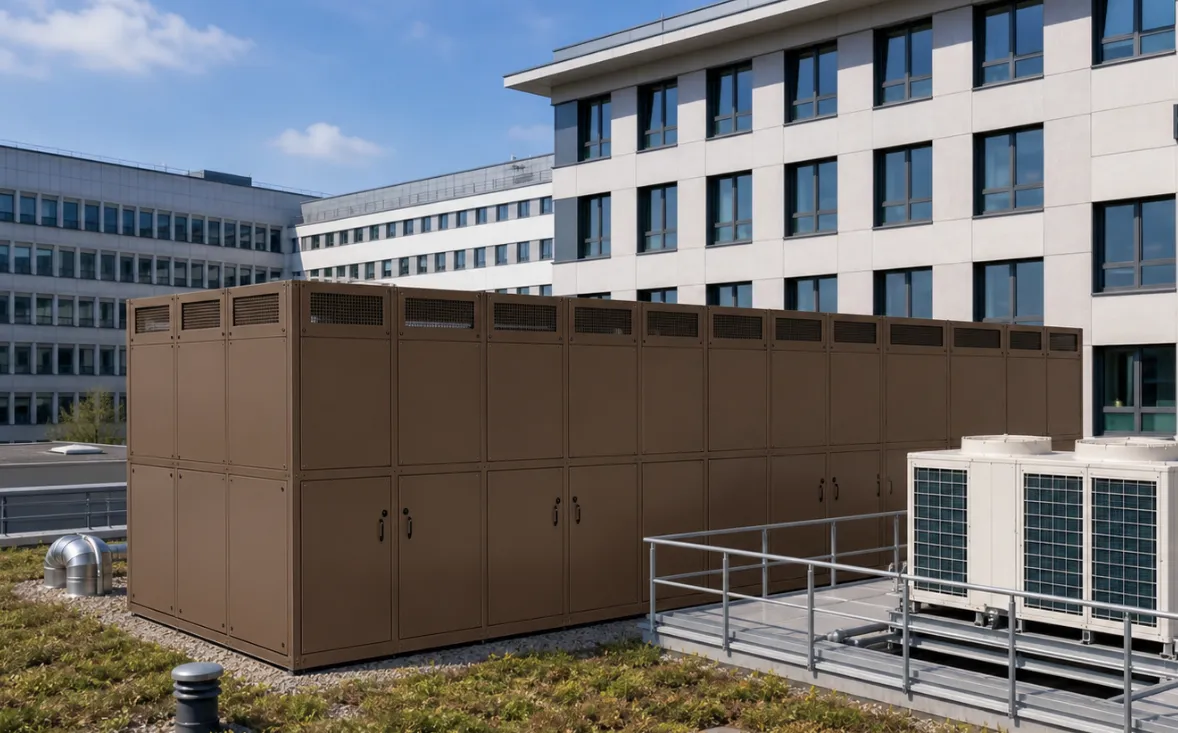 V-Series · standard product
VRF/VRV systems
Standard enclosures by model for Daikin, Mitsubishi Electric, Panasonic, LG, Samsung, Toshiba and Haier – at fixed prices.
View solution →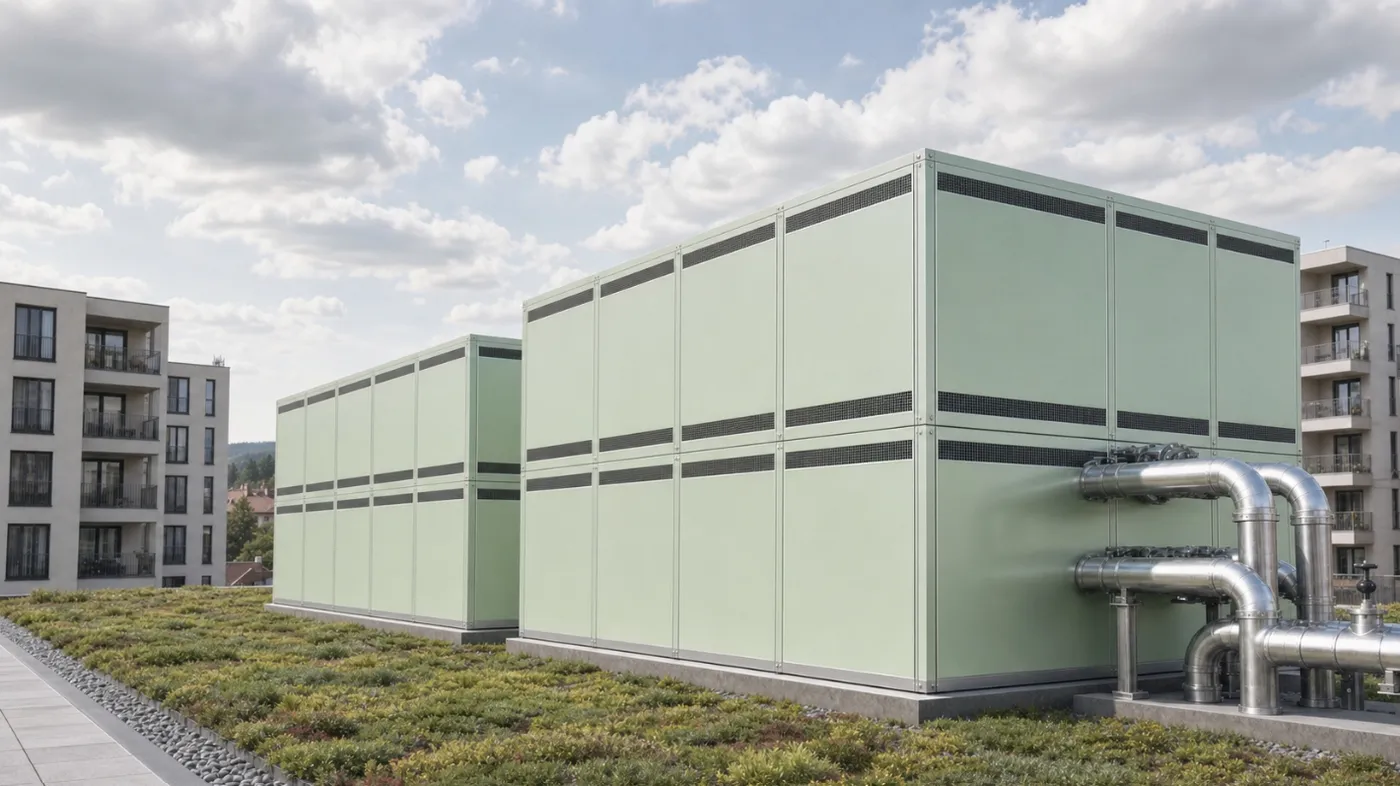 CM-Series · large units
Chillers & large heat pumps
Chillers, dry coolers, large heat pumps and cascades. Acoustics and air flow engineered together, A1 non-combustible.
View solution →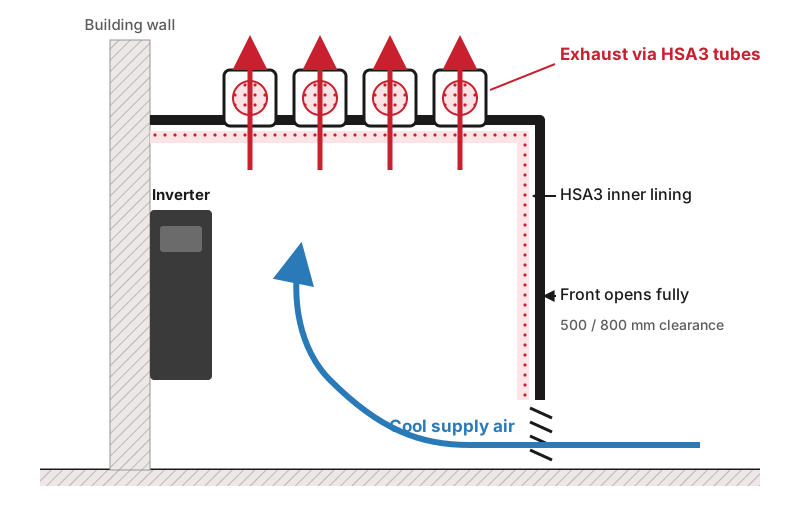 PV · battery storage
Inverters & BESS
Wall-mounted and free-standing enclosures for 1–5 inverters, enclosures for BESS. Designed for 16–18 kHz, A1 non-combustible.
View solution →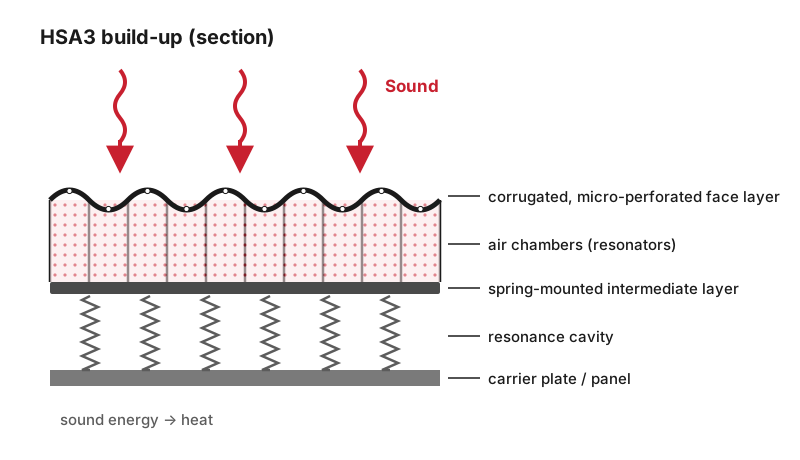 Material
HSA3 – the material in every enclosure
Acoustic meta-metal instead of mineral wool: non-combustible A1, weatherproof, strong at low frequencies.
HSA3 in detail →Request a project
Send us the unit type, quantity and location – or get a budget price straight from the configurator.
ForCoTech · Silent-Mode
Via Trento 22 · 23875 Osnago (LC) · Italy
E-Mail: info@forcotech.com