
Enclosing chillers and large heat pumps – without losing cooling or heating capacity
Above 100 kW, noise control becomes an air-flow task: a hundred thousand cubic metres of air per hour must pass through the enclosure, and the fan has only a few pascals in reserve. We engineer acoustics and air flow together – for one unit or the whole cascade.
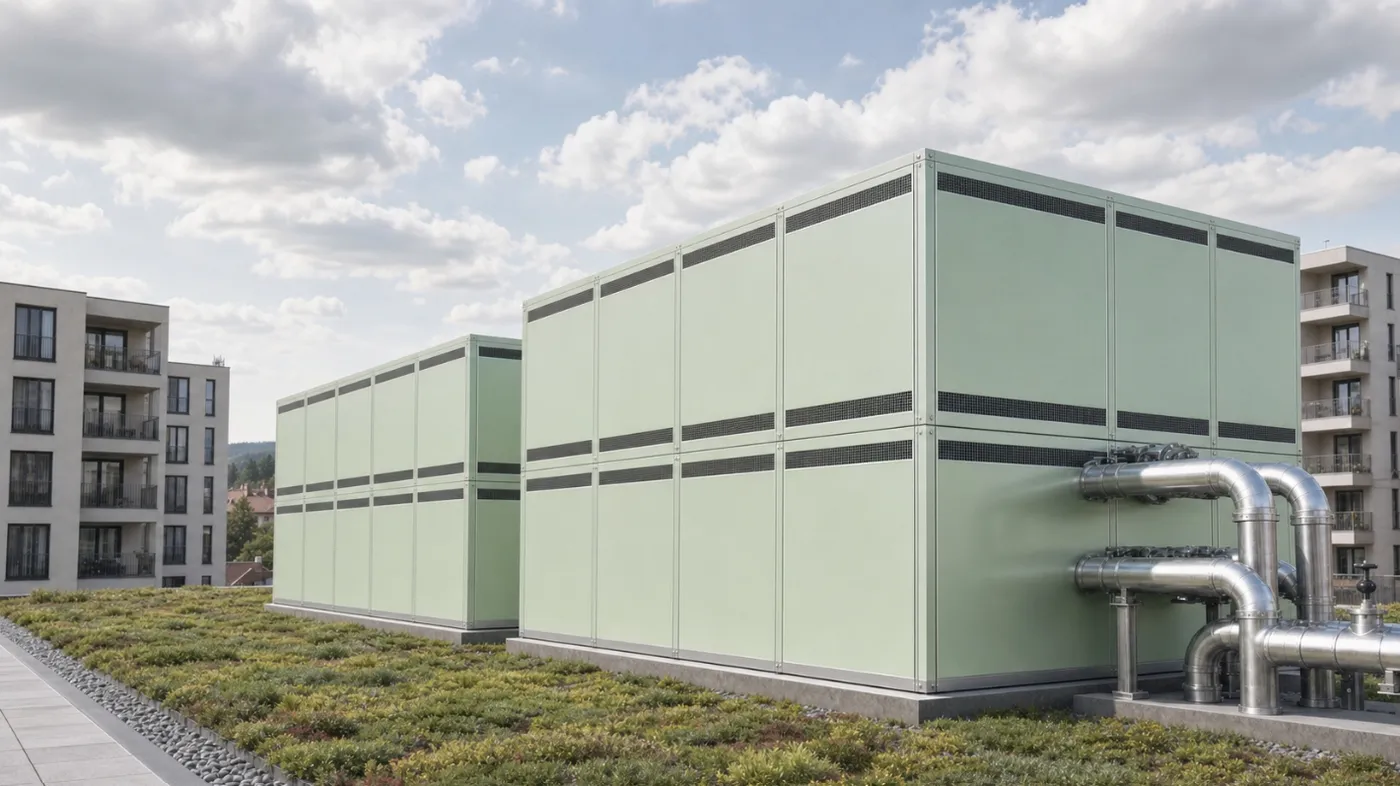
With large units, air decides – not insulation
A chiller or large heat pump moves tens to hundreds of thousands of cubic metres of air per hour. Every splitter, every grille costs pressure – and the fans usually have only a few pascals in reserve.
If the enclosure is too tight, the fan speeds up, the unit loses capacity and efficiency, and the level rises again. If warm or cold exhaust air recirculates into the intake, the unit trips on high pressure in summer or ices up in winter.
- Pressure reserve: Manufacturers often allow for only 30–35 Pa of additional pressure drop.
- Low frequencies: Compressors and large fans hum at 63–250 Hz – where classic splitters damp little.
- Cascades: Three, four or six units side by side – their levels add up, and the exhaust air affects the neighbouring units.
- Roof and structure: Steel splitter enclosures quickly add several tonnes to roof or steel frame.
- Flammable refrigerants: Large R290 heat pumps contain many kilograms of propane – the enclosure has to support the safety concept.
The CM-Series: acoustics and air flow in one design
We engineer every enclosure for sound and air together – from a single chiller to a shared enclosure for an entire cascade.
Tube silencers
HSA3 tubes Ø 200 mm in the discharge, with internal resonance chambers. They damp low frequencies and let the air pass almost unhindered.
Separate air paths
Supply air via the long sides, exhaust via the roof. A separating plane prevents exhaust air from being drawn in again.
Floorless
The enclosure stands around the unit without touching it. Structure-borne noise is not transmitted, and the unit stays on its foundation or frame.
Foundation or steel frame
Installation on a foundation with anti-vibration mounts or on a steel frame of any height – we adapt the enclosure height.
Lightweight build
Anodised aluminium profiles 45 × 45 mm, bolted instead of welded. Self-supporting frames over 12 m, transport without a crane.
A1 non-combustible
HSA3 inner lining without mineral wool or foam – important on roofs, at data centres and for R290 units.
Targets before we design the details
- Air velocity in the free openings ideally 5–7 m/s
- Reduction at the receiver usually 10–15 dB(A), night operation is decisive
- Capacity loss caused by the enclosure max. 3–5 %
Example: 100,000 m³/h at 5 m/s requires around 5.6 m² of free area – on the supply and on the exhaust side.
How we verify the design
- CFD simulation of air flow and pressure drop, including wind
- Noise prediction with octave-band sound power, distance and area type
- BIM model (IFC) for designers, MEP and site management
- Structure and wind load to EN 1991-1-4, also for roofs
- On-site differential measurement after installation
From single enclosure to plant room
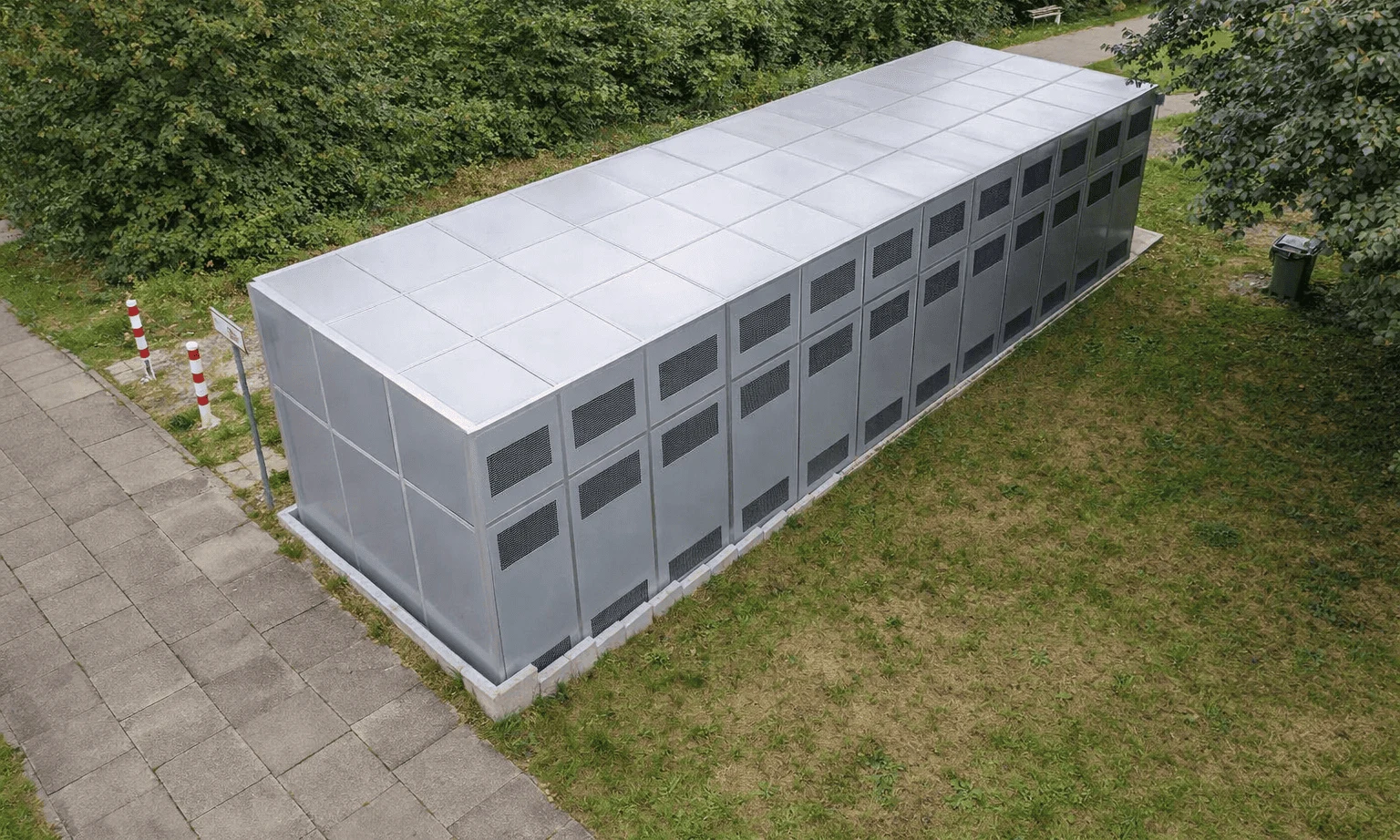
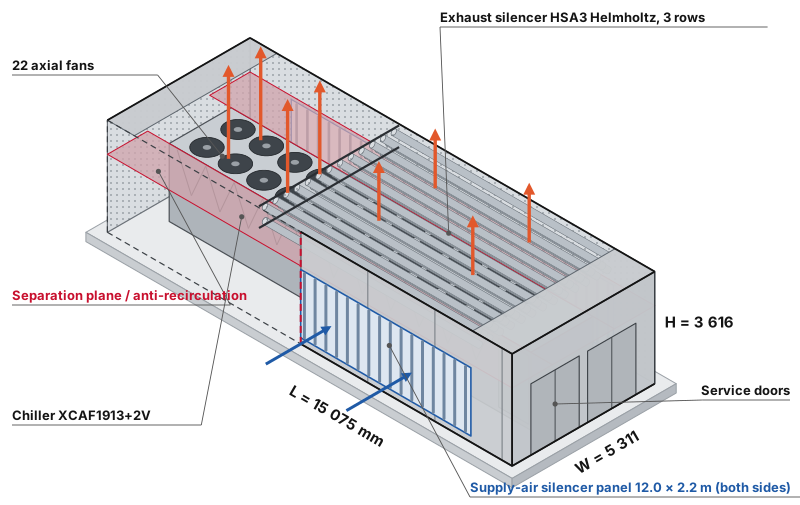
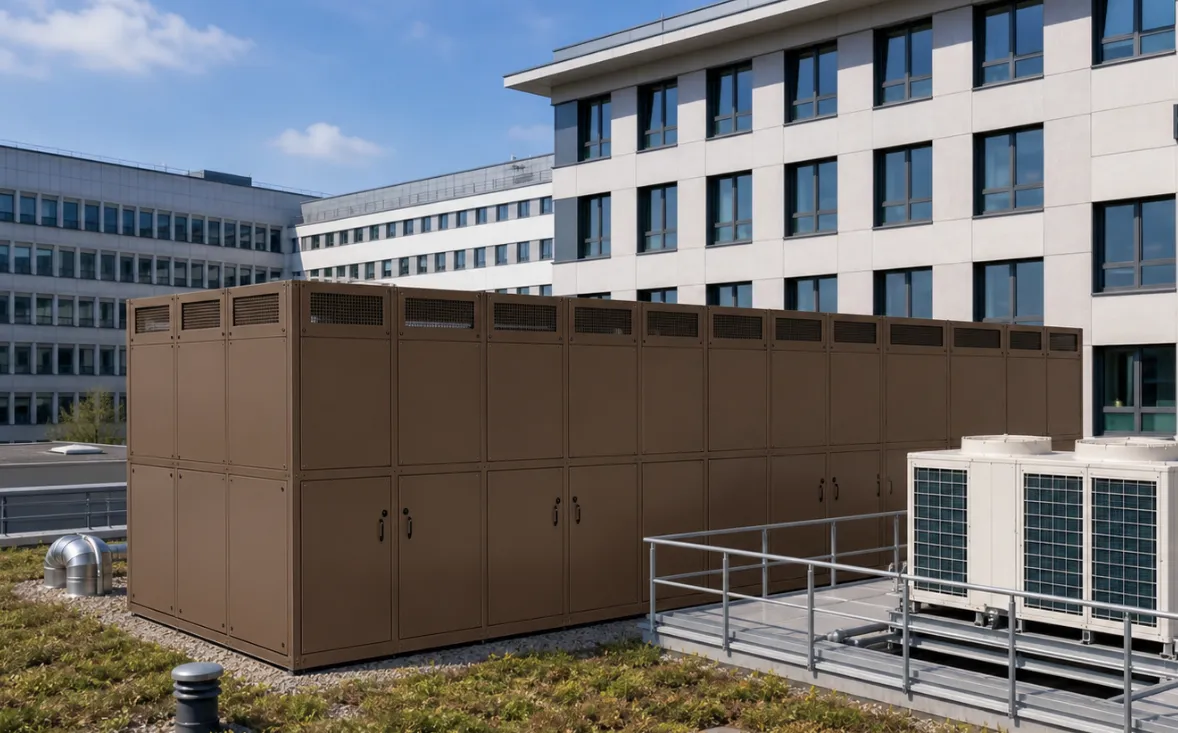
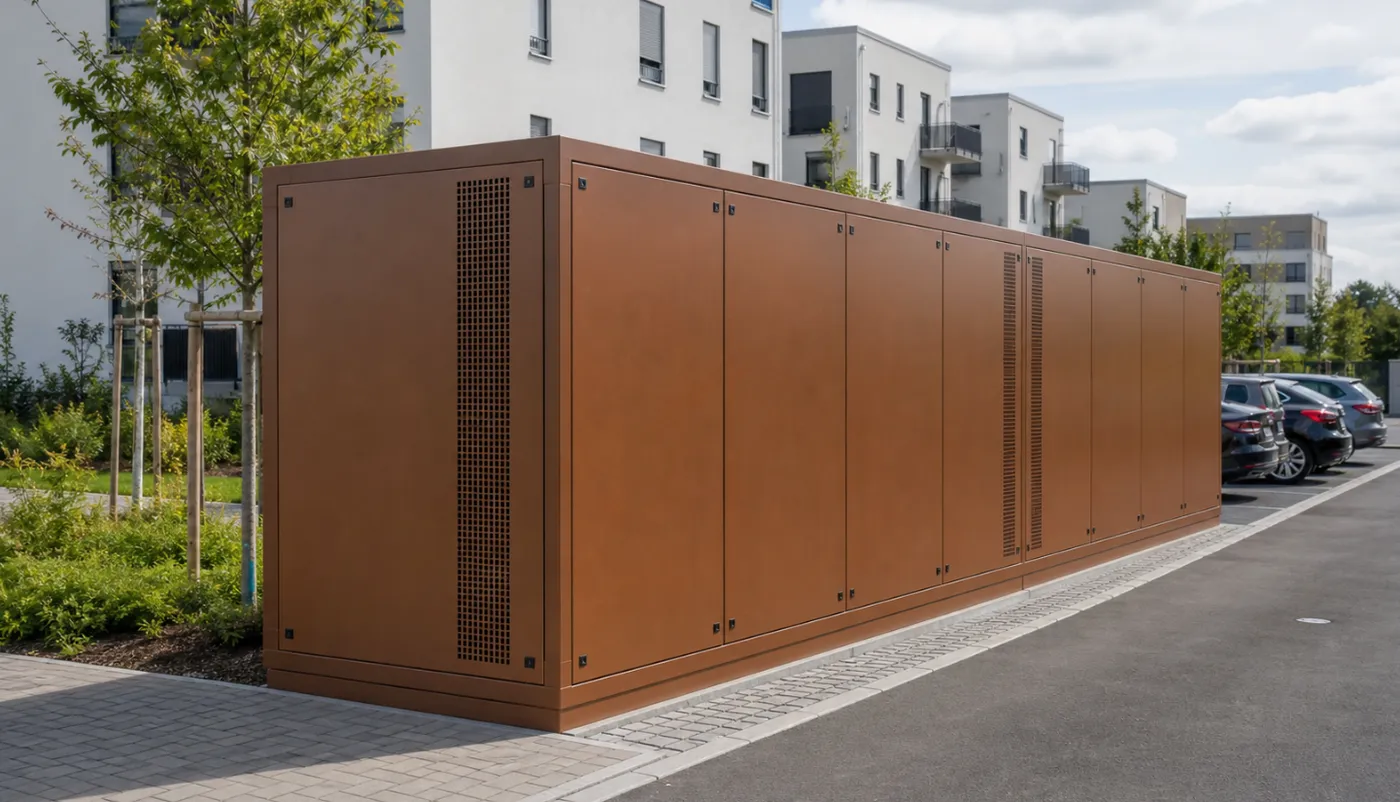
Partly visualisations or schematic drawings.
Guide prices for the best-selling large units
The large-equipment catalogue lists matching enclosures for chillers, large heat pumps and condensing units from Aermec, Bosch/Buderus, Carrier, Daikin, ENGIE Refrigeration, HiRef, LG, Mitsubishi Electric/Climaveneta, NIBE, Panasonic, Stiebel Eltron, Swegon, Thermocold, Trane, Vaillant, Viessmann, Weishaupt and YORK/Johnson Controls – with enclosure dimensions, weight and guide price per unit. Other units can be entered manually.
- Design standard: 800 mm at the sides, 900 mm above the unit for upward discharge, 100 mm for side discharge
- One unit, or two to three units under a shared enclosure; larger cascades per project
- Specification text, selection as PDF and BIM model to download
Guide price for your unit
Choose manufacturer and model, or enter dimensions and air volume – enclosure dimensions, weight and guide price appear instantly.
Frequently asked questions
How much pressure drop does the enclosure cause?
Little enough to stay within the unit's pressure reserve. We aim for 5–7 m/s in the free openings. HSA3 has up to 60 % less pressure drop than conventional splitter silencers; in the reference data centre we reach around 21 Pa at 380,000 m³/h.
Can several units share one enclosure?
Yes. In the catalogue, two or three identical units can be combined; for larger cascades we engineer the enclosure per project. An HSA3 partition between the units prevents exhaust air and levels from affecting each other.
Does this work with large R290 heat pumps?
Yes, with written approval from the manufacturer. The enclosure stays open at the bottom so propane can flow away, has permanently open openings on at least two sides and no ignition sources. We check the gas outflow by CFD.
What about dry coolers and condensers?
Here a top-mounted silencer above the fans is often enough instead of a full enclosure. We design it for air volume and fan pressure.
How is the effect verified?
In advance with a noise prediction, after installation with an on-site differential measurement.
More solutions
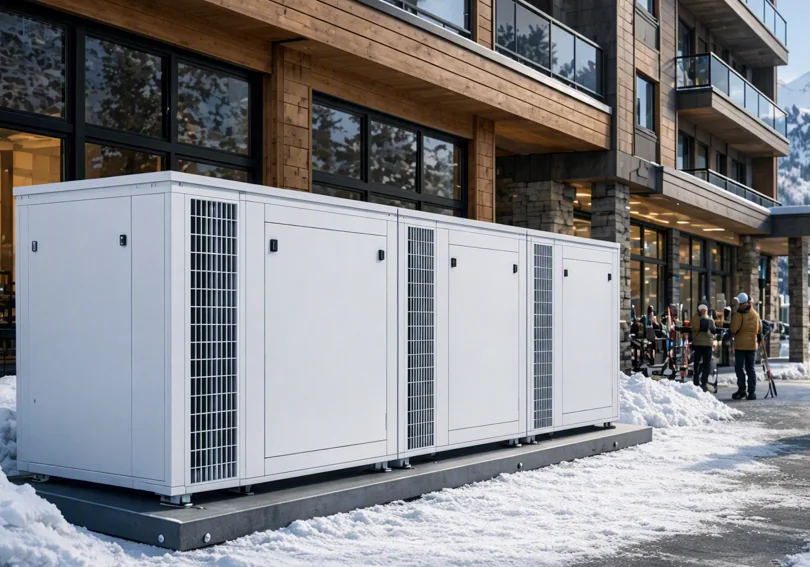 H-Series · small units
Heat pumps & air conditioning
Air-to-water heat pumps, split and AC units, pool heat pumps. Standard sizes H1–H12 or custom-made, up to −25 dB(A).
View solution →V-Series · standard productVRF/VRV systems
Standard enclosures by model for Daikin, Mitsubishi Electric, Panasonic, LG, Samsung, Toshiba and Haier – at fixed prices.
View solution →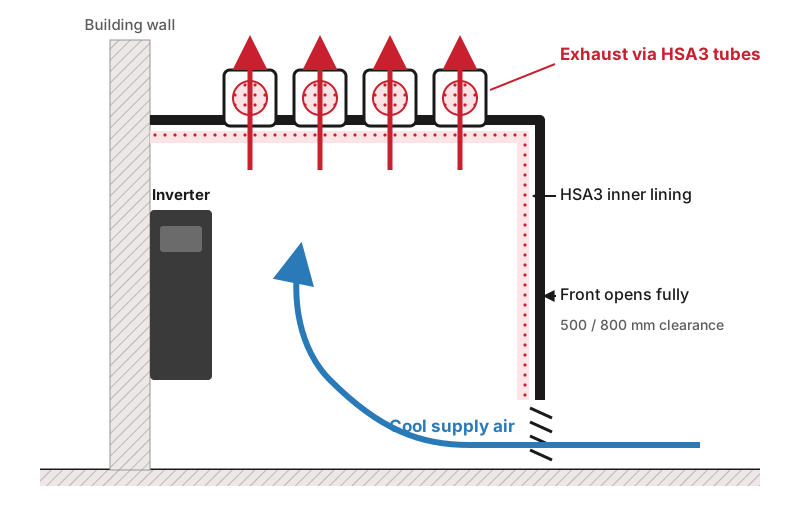 PV · battery storage
Inverters & BESS
Wall-mounted and free-standing enclosures for 1–5 inverters, enclosures for BESS. Designed for 16–18 kHz, A1 non-combustible.
View solution →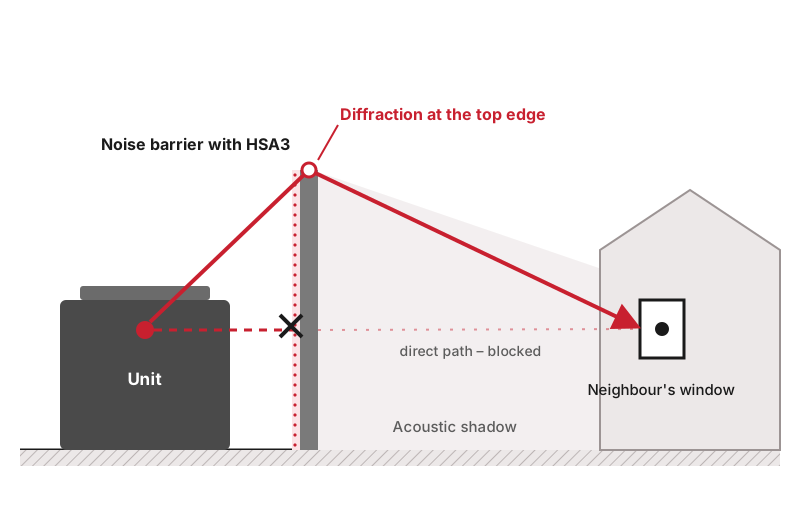 Wall-Series
Noise barriers
Straight, L-shaped, U-shaped or freely planned, with HSA3 absorber. Screening, wall height and wind load instantly.
View solution →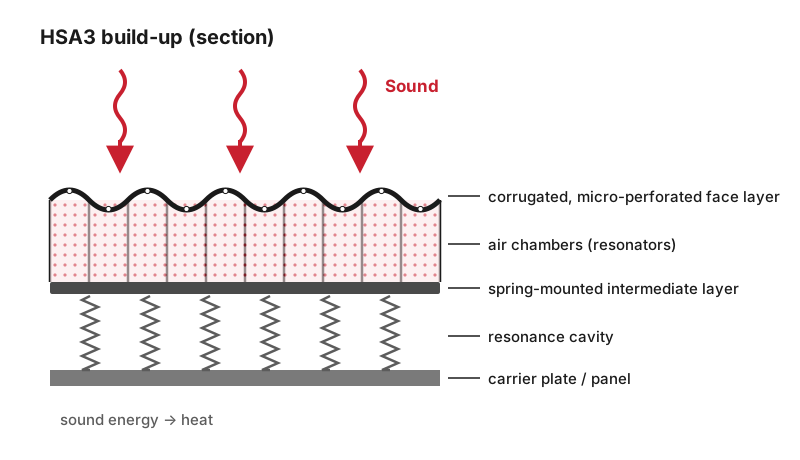 Material
HSA3 – the material in every enclosure
Acoustic meta-metal instead of mineral wool: non-combustible A1, weatherproof, strong at low frequencies.
HSA3 in detail →Request a project
Send us the unit type, quantity and location – or get a budget price straight from the configurator.
ForCoTech · Silent-Mode
Via Trento 22 · 23875 Osnago (LC) · Italy
E-Mail: info@forcotech.com